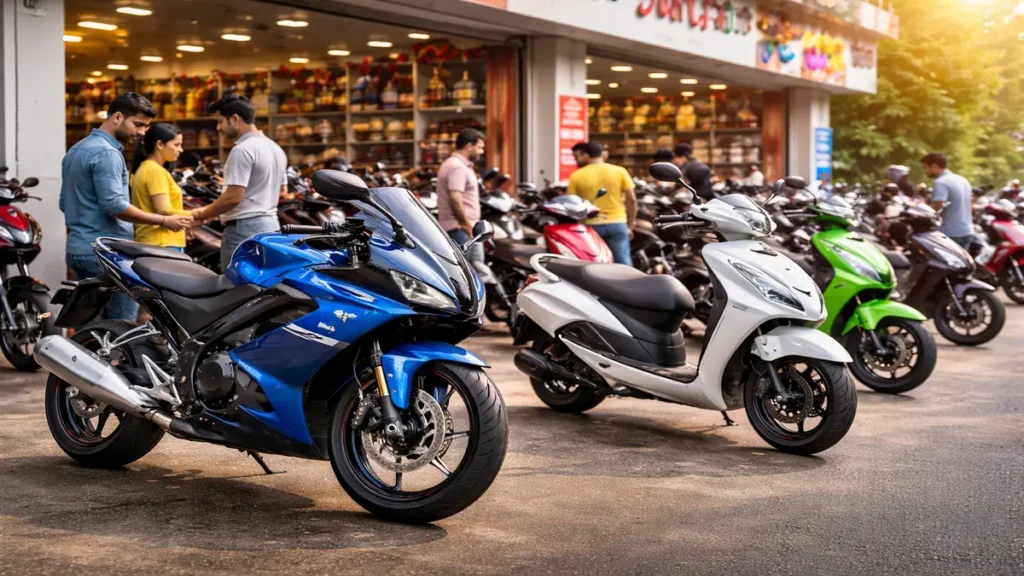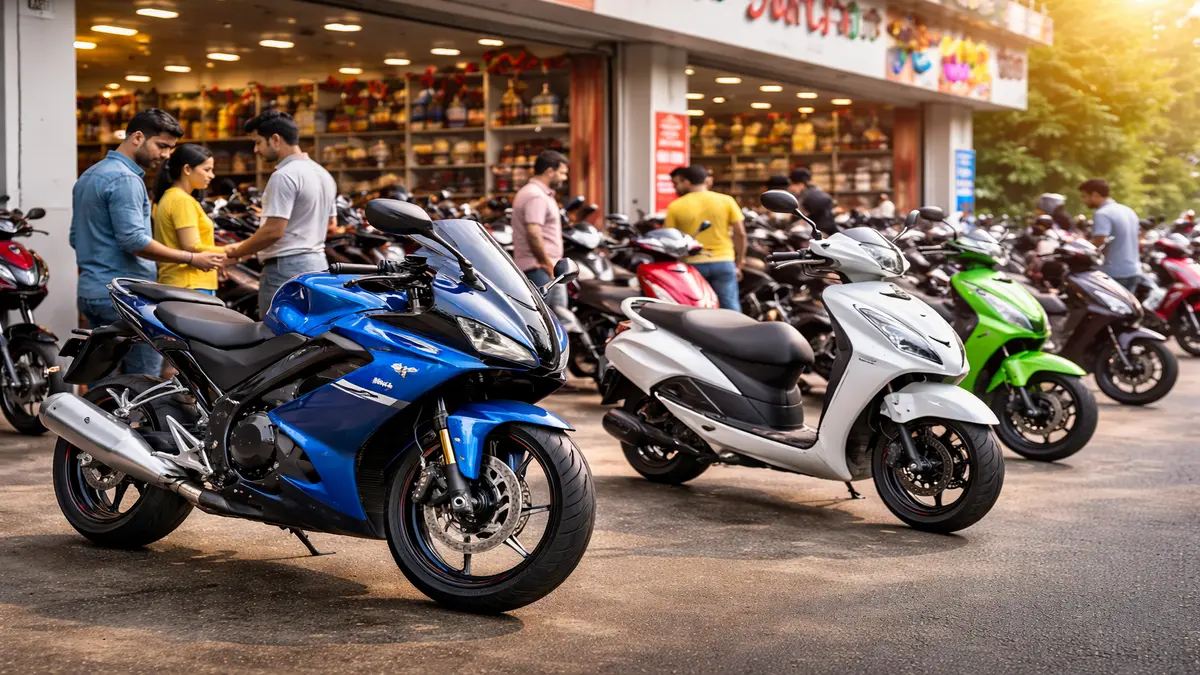
Two Wheeler Sales in India Cross 2 Crore Units Mark again. Read this detailed breakdown of scooter growth, commuter demand, EV impact, rural comeback, and what the milestone means for 2026.
India is a two-wheeler country. Always has been.
No matter how big the SUV trend gets, no matter how many EV launches happen every month, the truth is simple: India moves on two wheels.
So when the news came out that two-wheeler sales in India crossed the 2 crore units mark, it wasn’t just another industry headline. It was a strong signal that the Indian mobility market has regained serious momentum after years of slowdown, COVID impact, inflation pressure, and weak rural demand.
But what’s more interesting is how this milestone happened.
Because if you look closely, the story is not just “more bikes sold.” The story is about:
- scooters becoming the growth hero again
- EV two-wheelers quietly pushing volumes
- demand returning in rural India
- better financing and affordability
- shift in buyer mindset (especially youth + urban commuters)
In this detailed article, we’ll break down everything — in easy language and a real-world, Indian perspective — so that even a normal reader can understand what’s happening.
Two Wheeler Sales in India Cross 2 Crore Units Mark: What Exactly Happened?
As per data reported by auto industry trackers and publications, India’s two-wheeler sales/registrations crossed 2 crore units in 2025.
Autocar India reported that two-wheeler registrations reached around 2.02 crore units in 2025, compared to 1.892 crore in 2024, showing strong year-on-year growth.
At the same time, mainstream reporting based on SIAM indicated the segment crossed the 20-million mark in 2025 with YoY growth around 4.9–5%.
If you’re reading this and thinking, “But India always sells a lot of bikes, what’s so special about 2 crore?” — you’re right to ask.
Why 2 crore is a big deal
Because:
- It reflects a return to near-peak levels after a rough period
- It shows demand recovery in both rural + urban markets
- It puts the market close to the record levels of 2018 (~2.1 crore units) mentioned in reporting
In simple words: India’s two-wheeler market is back in action.
Quick Snapshot: 2024 vs 2025 Two-Wheeler Market
Here’s a simple comparison to understand the scale:
| Year | Approx Two-Wheeler Volumes | Trend |
| 2018 | ~2.1 crore (historic peak) | Record |
| 2024 | ~1.89 crore | Recovery phase |
| 2025 | ~2.02 crore | Crossed 2 crore |
Autocar India clearly highlights this comparison using Vahan-based registration data.
What Is Driving This Growth? (Real Reasons, Not Just Numbers)
If we simplify the reasons behind India crossing 2 crore two-wheeler sales, it mainly comes down to 7 big drivers:
- Scooter resurgence
- Rural demand slowly returning
- Better finance availability
- Entry-level commuter demand
- EV growth in two-wheelers
- Improved affordability factors
- Replacement cycle (old vehicles being replaced)
Let’s break each point in detail.
1) Scooters Are Back as the Growth King
If you had asked any bike dealer 3–4 years ago “what will grow faster: bikes or scooters?”, many would have said bikes.
But 2025 proved something else.
According to Autocar India’s report, scooters were a major growth driver behind the 2 crore milestone.
Why scooters are growing again:
- Perfect for city commuting
- High convenience for daily stop-go traffic
- Easy for new riders + women riders
- Storage + practicality
- Auto transmission (no clutch headache)
In big cities like Mumbai, Pune, Bengaluru, Delhi NCR, Hyderabad — scooters are almost like the default “first vehicle” now.
And here’s the real Indian truth:
In traffic, a scooter often feels easier than a bike.
No gears. No clutch. Less mental stress.
That human convenience translates directly into sales numbers.
2) Rural India Is Slowly Coming Back
For years, the two-wheeler industry depended heavily on rural demand. But rural income pressure, inflation, and financing tightened the market.
Now, demand is improving.
Industry reports linked growth with:
- improved affordability
- positive sentiment
- better financing conditions
- more stable rural mobility demand
SIAM’s recent quarter performance releases also highlight resilient rural demand supporting the two-wheeler segment.
Why rural demand matters so much:
Because rural buyers don’t upgrade yearly. They buy with careful planning.
When rural confidence returns, sales jump hard.
A bike in rural India is:
- commute tool
- family vehicle
- farm support vehicle
- “connectivity” machine for villages
3) Financing Became Easier Again
Let’s be honest — many Indians don’t buy bikes with full cash now.
The EMI mindset is everywhere.
Industry reporting in early 2026 pointed out that improved affordability and easing financing costs helped boost consumer demand.
What changed in real life?
- More loan options for entry-level buyers
- Better approval rate (vs strict period earlier)
- Schemes during festive season
- Low down-payment offers
Even if the buyer is financially stable, many still prefer EMI because:
- keeps cash in hand
- small monthly burden feels easier
- instant purchase decision
This is exactly why the two-wheeler market reacts so quickly when financing becomes smoother.
4) The Commuter Segment Still Runs India
Even with all the hype around KTM, Royal Enfield, big bikes, etc. — the truth is:
India is still a commuter two-wheeler market.
100cc to 125cc bikes remain the backbone.
These buyers focus on:
- mileage
- low service cost
- resale value
- reliability
This is why brands like:
- Hero MotoCorp
- Honda
- Bajaj
- TVS
still dominate overall volumes.
This commuter demand is always present — but when sentiment improves, it grows fast.
5) EV Two-Wheelers Added a Solid Push
EVs are no longer a “future concept.”
They are now a visible part of daily traffic.
A Times of India report based on Vahan Portal insights highlighted that EV sales in 2025 hit 2.3 million units and two-wheelers dominated EV sales with 1.28 million units.
That’s big.
Because even if you remove pure petrol/diesel market growth, EV two-wheelers are now adding their own volume layer.
Also, FADA retail data mentions EV share improvement in 2W (7.40% vs 6.13% earlier) showing rising acceptance.
Why EV two-wheelers work in India:
- Cheap running cost
- Great for city delivery + office commute
- Government incentives in many states
- No gear stress
- Silent + smooth ride
Basically, EV scooters have become the “new Activa” for certain city buyers.
6) Replacement Cycle is Helping Too
Another reason India reached 2 crore in 2025 is replacement demand.
Many people who bought:
- bikes in 2016–2019
are now upgrading because: - old vehicle is tired
- maintenance cost increasing
- better features now
- mileage drop over time
Replacement demand is very powerful because it doesn’t depend heavily on “new buyers.” Even if new buyer growth is slow, replacement keeps sales stable.
7) Market Confidence Returned
This is not talked about enough, but sentiment matters a lot.
People buy two-wheelers when:
- they feel financially stable
- job feels secure
- business feels stable
- future looks predictable
When fear is high, people delay purchase.
In 2025, confidence improved — which is why sales crossed a symbolic big number.
Two-Wheeler Market Segments: What’s Selling the Most?
Now let’s talk about the actual market categories.
Indian two-wheeler market can be divided into:
- Entry commuter motorcycles (100–125cc)
- Premium commuter (125–160cc)
- Performance bikes (150–250cc)
- Premium bikes (250cc+)
- Scooters (ICE + EV)
Segment trend in 2025:
- Scooters grew faster than expected
- Entry commuter demand stayed strong
- Premium bike market improved but not at scooter-level
- EV scooters added extra volume
Comparison Table: Why Buyers Choose Each Segment
| Segment | Best For | Pros | Cons |
| 100–110cc bikes | mileage + low cost | cheapest running, strong resale | basic feel |
| 125cc bikes | balanced riders | mileage + better pickup | slightly higher maintenance |
| 150–200cc bikes | youth buyers | style + power + features | lower mileage |
| 250cc+ bikes | enthusiasts | touring + strong performance | expensive service & tyres |
| ICE scooters | city commute | easy ride, storage | not ideal for highways |
| EV scooters | urban daily rides | lowest running cost | charging dependence |
What This Means for Major Brands (Hero, Honda, Bajaj, TVS)
When India crosses 2 crore sales, it doesn’t mean every company benefits equally.
Biggest winners usually are:
- Companies strong in scooters
- Companies strong in commuter segment
- Companies with dealer reach in rural India
This is why:
- Honda remains extremely strong (Activa effect is real)
- Hero stays strong in mass commuter market
- TVS benefits from both scooter + sporty mix
- Bajaj benefits from commuter + 125–160cc
And EV growth helps players like:
- Ola Electric
- Ather
- TVS iQube lineup
- Bajaj Chetak
EV makers may not beat Hero/Honda in total volumes yet, but their growth speed is crazy.
Read More
Hyundai Loniq 6 Review: Stylish, Futuristic & Fully Electric Car in India
Kia EV9 Review 2025 – Specs, Price, Range & Global Market Insights
Kia EV3 – The Compact Electric SUV Redefining Affordable EV Mobility
Dealer-Level Reality: What Dealers Are Seeing
Let me explain something that most people don’t notice:
When a market crosses a milestone, you can see it at dealer level before it becomes official data.
Dealers generally report:
- more enquiries during festive season
- more “finance buyers”
- more replacement buyers
- bigger demand for scooters
- people upgrading from 100cc to 125cc
Also, delivery-related demand has increased. Thousands of new delivery riders enter the market annually (Swiggy/Zomato/Flipkart/Amazon), and most require a two-wheeler.
EV Two-Wheeler Impact: Threat or Opportunity?
Here is the honest answer:
EV is both a threat and an opportunity.
Opportunity:
- new customers entering market
- new category expansion
- scooter volumes increasing
Threat:
- ICE scooter market gets disrupted
- service revenue changes (EV needs less maintenance)
- traditional manufacturers must innovate
But since EV share is still a portion of the total market, it currently works more like market expansion than market destruction.
Challenges Still Exist (It’s Not Perfect Yet)
Yes, India crossed 2 crore. But there are still concerns:
1) Still below 2018 peak
The 2018 peak (~2.1 crore) remains the historic benchmark mentioned in reporting.
2) Affordability pressure remains
Bike prices have increased a lot in the last few years.
A basic commuter bike today costs much more than 2016–2018.
3) Insurance + fuel cost
Fuel cost hits daily riders.
Insurance cost affects new buyers.
4) Urban traffic “hate”
Some buyers shift to metro/public transport in big cities.
But for last-mile, the scooter is still king.
What Happens Next? (2026 Outlook)
If the same momentum continues, India can sustain above 2 crore units yearly.
But growth depends on:
- rural income stability
- inflation control
- financing ease
- EV infrastructure growth
SIAM data indicates overall segment recovery and quarter-wise strong numbers for two-wheelers.
What I personally feel:
- Scooters + EV scooters will grow fastest
- 125cc bikes will keep rising (people want slightly more power now)
- premium bike market will remain niche but stable
FAQs-Two Wheeler Sales in India Cross 2 Crore Units Mark
1) When did two-wheeler sales cross 2 crore units in India?
Reports indicate 2025 saw two-wheeler registrations/sales crossing the 2 crore mark, with around 2.02 crore units registered according to market tracking.
2) What was the two-wheeler sales figure in 2024?
Autocar India noted around 1.892 crore registrations in 2024, which increased in 2025.
3) What was the highest ever two-wheeler sales in India?
The market peak is often referenced around 2.1 crore units in 2018.
4) Which segment is driving growth – bikes or scooters?
Scooters played a major role in growth and emerged as a key driver in 2025.
5) Is EV two-wheeler sales contributing to this milestone?
Yes. EV adoption increased strongly, and two-wheelers dominated EV sales (1.28 million units mentioned in reporting).
6) What’s the biggest reason behind this market recovery?
A mix of improving demand sentiment, better financing access, scooter growth, and gradual rural recovery supported volumes.
7) Will sales keep growing in 2026?
If demand and financing remain supportive, the market can stay above 2 crore units. Quarter performance data suggests continued strength.
Final Words: Why This 2 Crore Milestone Matters
Two crore is not just a number.
It tells us that:
- Indian families are spending again
- daily commuting needs are rising
- scooters are back in demand
- EV two-wheelers are becoming normal
- and India’s mobility story is still powered by two wheels
If you’re a buyer, it means more options and better competition.
If you’re a brand, it means the game is heating up again.
And if you’re a normal Indian rider like most of us — it simply means the roads are going to get even more crowded, so ride safe and maintain your bike properly.