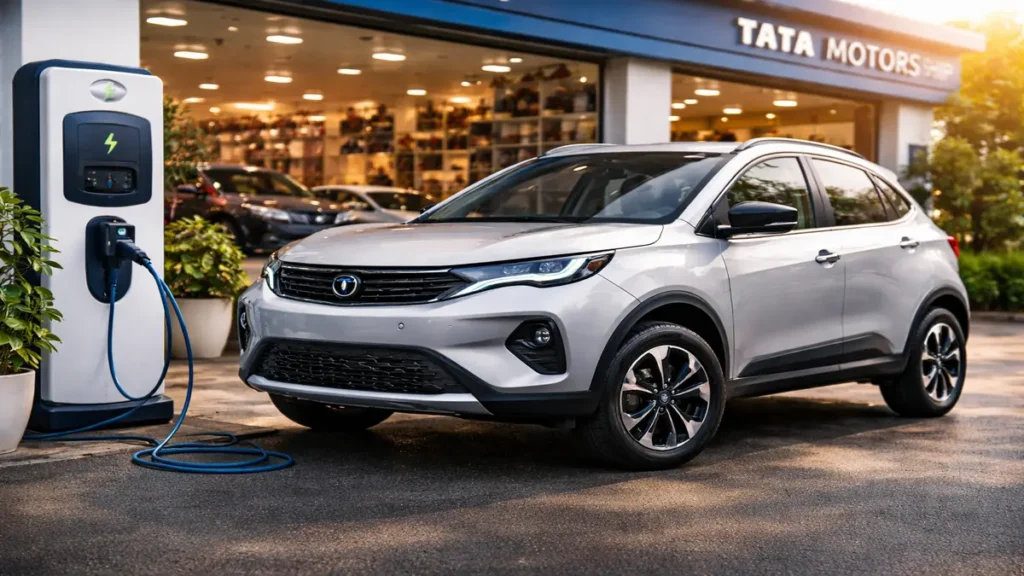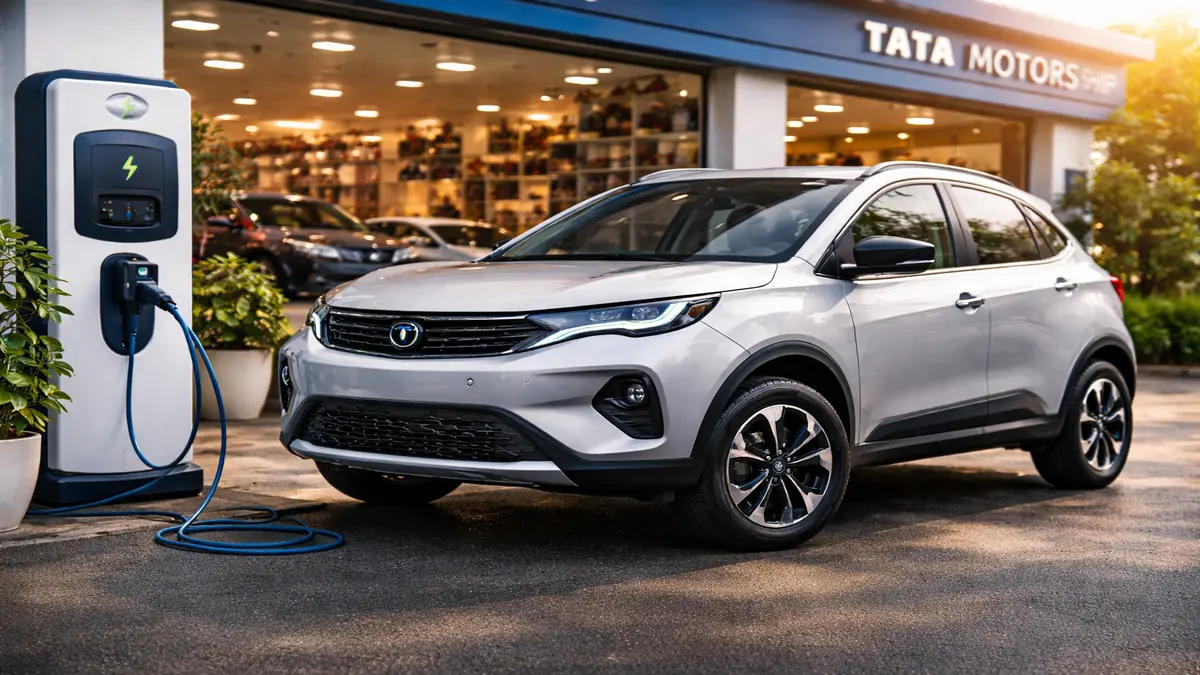
Tata Motors to Launch New Affordable EV in India for India. Here’s everything to know—expected price under ₹10 lakh, range, features, charging, competition, and what it means for buyers in 2026.
For the last few years, if you asked any Indian car buyer one simple question —
“Do you want an EV?”
Most people would say:
“Yes… but it’s expensive.”
And that’s the real issue.
In India, the electric car dream becomes serious only when the price drops into the “normal family car” zone. Not ₹20 lakh. Not ₹25 lakh. Not even ₹15 lakh for many households.
The real game starts under:
- ₹10 lakh (ideal)
- ₹12 lakh (maximum practical for mass market)
That is exactly where Tata Motors is now preparing its next big move.
Tata already dominates India’s EV space compared to most rivals. But Tata also knows one truth very clearly:
EV adoption will explode only when EV prices feel like petrol car prices.
That’s why talk around Tata Motors to Launch New Affordable EV in India for the Indian market is not just exciting — it’s strategically important for the whole Indian EV ecosystem.
This article will explain:
- why Tata is planning a more affordable EV
- what it could be based on
- where it could be priced
- what features Indian buyers expect
- and what this means for competitors like Maruti, Hyundai, Mahindra, MG, and even Chinese entrants
Let’s break it down in real-world Indian terms.
1) Why Tata Is Focusing on an Tata Motors to Launch New Affordable EV in India
Even today, EV sales are growing, but not “mass market” level.
Yes, you’ll spot more Nexon EVs, Punch EVs, Tiago EVs — and even premium EVs — but it’s still a small share of overall car sales.
The big reason is simple: price + trust + infrastructure.
Tata understands this because it’s already in the market and listening to real buyers daily.
Recently, Tata Passenger EV MD & CEO Shailesh Chandra publicly urged the government to provide targeted support for EVs priced below ₹10 lakh, explaining that mass adoption remains difficult due to structural cost barriers in that segment.
Now think about what that statement really means:
If Tata itself is saying affordability is a barrier under ₹10 lakh, then Tata is also hinting strongly that:
they want to push EVs under ₹10 lakh
but costs are limiting it
so Tata needs policy help OR cost breakthrough
This is why the “affordable EV launch” story has gained serious attention.
2) Tata Motors to Launch New Affordable EV in India Lineup (And the Gap)
Right now, the most affordable Tata EV is the Tiago EV, which starts from ₹7.99 lakh (ex-showroom).
Tata EV range (as of early 2026) includes:
- Tiago EV (most affordable)
- Punch EV (starts around ₹9.99 lakh as per Tata EV site range listing)
- Nexon EV
- Harrier EV (now part of Tata.ev website)
- And upcoming models like Sierra EV, Avinya etc.
So what’s missing?
Tata already has a Tiago EV. Then why “new affordable EV”?
Because the market is changing.
The gap is not only price — the gap is value.
Many Indian buyers want:
- SUV-style design (even at low price)
- long range (350+ km claimed)
- fast charging
- modern cabin
- 6 airbags
- connected features
Tiago EV is affordable, but it’s still a hatchback with a city-focused identity.
Tata likely wants another product that can:
- widen entry market
- attract first-time EV buyers
- fight MG Comet + upcoming Maruti EV strategies
- and expand EV penetration into smaller cities
3) What Could Tata’s New Affordable EV Be?
Now, let’s talk about possibilities based on Tata’s roadmap and market signals.
Possibility A: A New Low-Cost EV Based on Tiago / New Platform
Tata can improve Tiago EV further, but for a “new EV” they might launch:
- a new body style
- new batteries
- more range
- upgraded interior
Tiago EV has already received updates in 2025 — including infotainment system updates and other improvements as per CarWale “latest updates”.
This shows Tata is actively refreshing its EV.
Possibility B: Punch EV “Lower Variant” Strategy
Punch EV already sits near ₹10 lakh entry point (on Tata EV listing).
Tata can also bring:
- more aggressive base variants
- smaller battery option
- “smart” trims with fewer premium features
This is a common strategy: keep prices low and upsell upgrades.
Possibility C: A Dedicated Sub-₹10 Lakh EV (New Nameplate)
This is the biggest market disruptor.
A true “mass EV” under ₹10 lakh could become:
- India’s EV WagonR moment
- India’s EV Alto moment
However — for a dedicated sub-₹10 lakh EV, Tata will need:
- huge localization
- cost-optimized battery pack
- simplified feature list
- incentives / tax benefits
That is exactly why Tata CEO is asking government support for under ₹10 lakh EVs.
Possibility D: Sierra EV / Avinya? (Not Affordable)
Some people misunderstand and assume Tata’s next launch is “affordable EV” but Tata has confirmed premium plans too.
Autocar India reported Tata’s 2026 EV plan includes:
- Sierra.ev
- updated Punch.ev
- Avinya (premium EV brand)
These are exciting, but not “affordable EV” in true mass-market sense.
So your blog topic “new affordable EV” clearly refers to the under ₹10–12 lakh segment and future low-cost nameplates.
4) Expected Price Range of Tata Motors to Launch New Affordable EV in India
Let’s be realistic.
Tata already sells the Tiago EV at ₹7.99 lakh.
So a “new affordable EV” will likely fall into:
Most likely pricing:
- ₹8.5 lakh to ₹11.5 lakh (ex-showroom)
If Tata tries to go super aggressive:
- ₹6.99 lakh starting price (very hard)
- ₹7.49 lakh starting price (possible with incentives)
But the reality is battery costs still matter.
This is why Tata is asking for government aid specifically for EVs priced under ₹10 lakh.
So expectation should be:
affordable
but still usable range
not overpriced like premium EVs
5) The #1 Thing Indian Buyers Want: Range That Feels “Enough”
EV buyers are obsessed with range.
Even if their daily driving is 30 km/day, people want range “for peace of mind.”
Indian buyer psychology:
- 250 km range feels “risky”
- 300 km feels “okay”
- 350 km feels “safe”
- 400+ km feels “future proof”
The Tiago EV’s “up to 293 km range” claim (from Tata’s own site) shows Tata can offer a decent entry range already.
But for the next affordable EV, Tata will likely aim for:
- 300–350 km claimed range (mid variants)
- fast charge support (10–80% under 1 hour in ideal conditions)
6) What Features Will Tata Motors to Launch New Affordable EV in India to Win India?
If Tata launches a new Tata Motors to Launch New Affordable EV in India today and gives only “basic features,” it won’t create buzz.
Indian buyers have changed.
Even budget buyers today want:
- touchscreen infotainment
- reverse camera
- connected features
- digital cluster
- good speakers
- fast USB charging
- 6 airbags (especially after safety awareness growth)
Likely feature list in Tata Motors to Launch New Affordable EV in India:
- 7–10 inch infotainment system
- wireless Android Auto/Apple CarPlay (mid/high)
- rear camera + sensors
- automatic climate control in top trims
- multi-drive modes
- regen modes (strong/weak)
- OTA updates (maybe)
If it’s based on new generation Tata cabins, it may also include:
- freestanding screen design
- better dashboard quality
- better seat fabric for heat resistance (important in India)
7) Charging & Infrastructure: Tata’s Biggest Advantage
Tata is not just a car maker. It’s an ecosystem maker.
Tata has:
- Tata Power charging
- Tata dealerships
- Tata service network
That matters because EV adoption is not only about the car, it’s about:
- charging comfort
- service confidence
- resale trust
This is also why Tata keeps leading in Indian EVs even when competitors enter.
8) Competition: Who Tata Is Targeting With This Tata Motors to Launch New Affordable EV in India?
Let’s be blunt.
Tata Motors to Launch New Affordable EV in India move is targeting:
- first-time car buyers
- two-wheeler-to-car upgrade buyers
- urban commuters
- small families
- fleet buyers (small scale)
- office commuters looking for low running cost
Direct competitors:
- MG Comet EV (starts ~₹6.24 lakh as per CarWale list)
- future Maruti entry EV
- Hyundai’s planned small EV strategies
- Mahindra lower segment EVs (if any)
- VinFast and new entrants (mid-range though)
The MG Comet is the biggest low-cost EV reference right now. Tata might answer it with something more practical.
9) Comparison Table: Tata Motors to Launch New Affordable EV in India vs Key Rivals
| Brand/Model | Price Zone | Strength | Weakness |
| Tata Tiago EV | ₹8–11L | trusted brand, practical | hatchback feel |
| Tata Punch EV | ₹10L+ | SUV stance, better presence | higher price |
| MG Comet EV | ₹6–9L | cheapest EV option | small + limited highway comfort |
| Nexon EV | ₹12L+ | feature-rich | not truly budget |
| Future Maruti EV | unknown | service reach | EV trust still building |
10) Will Tata Bring a Nano EV? (Reality Check)
Online blogs often speculate “Nano EV comeback.”
But most of those sources are not reliable, and many claims sound unrealistic.
The trustworthy sources are:
- Tata’s official EV site
- major auto publications (Autocar India, etc.)
- mainstream business reporting
From official and credible sources, Tata’s confirmed roadmap talks about:
- Sierra.ev
- updated Punch.ev
- Avinya premium EV brand
So instead of believing random viral headlines, it’s better to focus on what Tata is truly building.
11) What This Means for Indian Buyers
If Tata launches a new affordable EV:
EV becomes normal in middle-class households
EV resale market grows
more charging points come up
petrol hatchbacks face pressure
running cost advantage becomes mainstream
Real example (owner thinking):
If petrol costs ₹110/litre and your daily travel is 40 km:
- Petrol car monthly fuel bill = easily ₹6,000–₹9,000
- EV monthly charging bill = usually ₹800–₹2,000 (depending on tariff)
Even if EV price is slightly higher, the running cost is attractive.
Read More
Hyundai Loniq 6 Review: Stylish, Futuristic & Fully Electric Car in India
Kia EV9 Review 2025 – Specs, Price, Range & Global Market Insights
Kia EV3 – The Compact Electric SUV Redefining Affordable EV Mobility
12) Will Tata Motors to Launch New Affordable EV in India Make Petrol Cars Obsolete?
Not immediately.
India will remain mixed:
- petrol/diesel
- CNG
- EV
- hybrid (especially in future)
But yes, affordable EVs can slowly damage the petrol hatchback segment.
Because petrol hatchback buyers are the most mileage-sensitive.
If they see EV offering “cheaper than petrol running,” they will consider it seriously.
FAQs: Tata Motors to Launch New Affordable EV in India
1) Is Tata Motors launching a new affordable EV in India?
Tata is actively working toward wider EV adoption and has publicly highlighted the need for policy support for EVs under ₹10 lakh, which directly signals focus on mass-market affordable EVs.
2) What is the cheapest Tata electric car currently in India?
The Tata Tiago EV is currently the most affordable Tata EV, starting at ₹7.99 lakh (ex-showroom).
3) What new Tata EVs are confirmed for 2026?
Tata has confirmed Sierra.ev, an updated Punch.ev, and the premium Avinya brand for 2026, according to Autocar India.
4) Will Tata’s new affordable EV be under ₹10 lakh?
That is Tata’s likely direction, but pricing depends heavily on battery costs and policy support. Tata’s leadership has said under ₹10 lakh EV adoption needs government assistance.
5) Is the Tata Punch EV affordable?
Punch EV is among the more affordable SUV-style EVs and Tata’s official EV range listing shows it starting around ₹9.99 lakh.
6) What range can we expect from Tata Motors to Launch New Affordable EV in India?
A practical affordable EV range target in India would be around 300–350 km claimed, similar to how Tata already offers Tiago EV up to 293 km claimed range.
7) Will Tata bring more EVs after 2026?
Yes. Tata has stated plans for additional EV nameplates by FY30 along with expanding its charging ecosystem.
Final Thoughts: Tata Motors to Launch New Affordable EV in India Could Be a Game Changer
If Tata truly nails a well-priced, practical, real-world affordable EV, it could become one of the most important Indian car launches of the decade.
Because once EV enters the “normal budget family car” zone, the market changes completely.
Petrol prices won’t come down. Cities won’t become less crowded. Commuting costs won’t reduce.
So an affordable EV isn’t just a new model launch — it’s a new chapter in Indian mobility.