
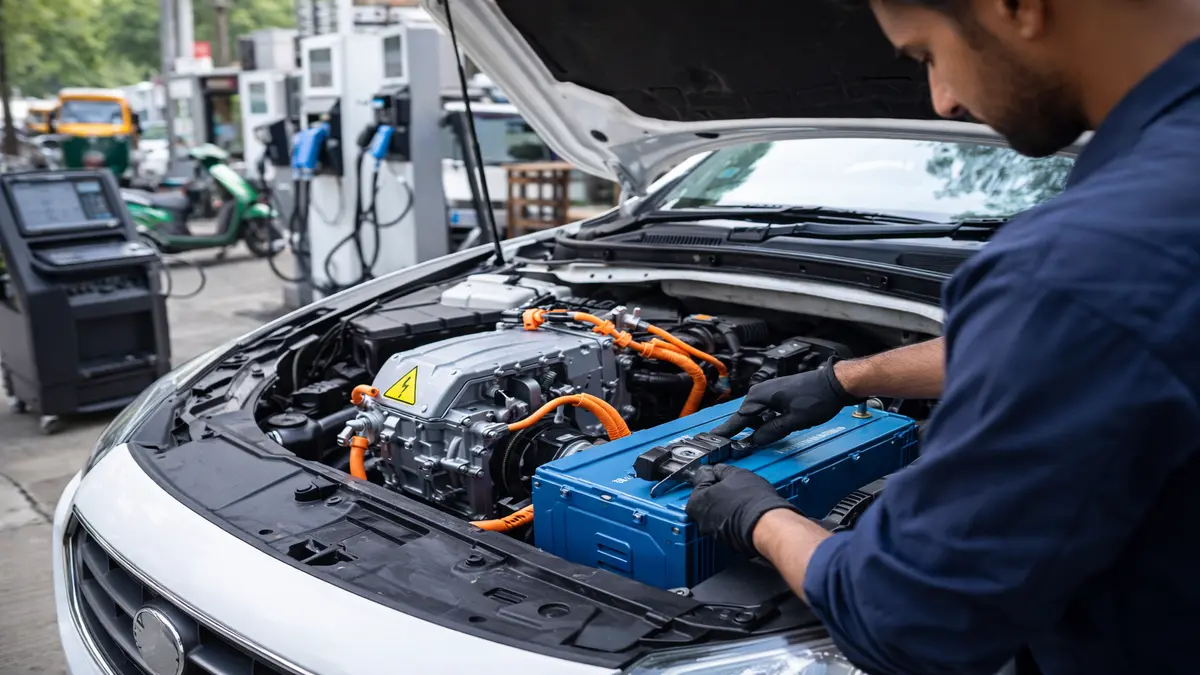
Delhi EV Retrofitting Push raises concerns over safety, approvals, cost and responsibility. Full explained report with real impact on car owners.
Hello friends, hope you’re doing well today.
Delhi is again in the middle of an important mobility debate—this time about EV retrofitting, which basically means converting old petrol/diesel vehicles into electric ones using retrofit kits. On paper it sounds like a smart shortcut to reduce pollution. But in reality, this push has started raising serious concerns in the auto industry—especially around safety, technical standards, and business impact.
So friends… Do you know it’s very special or unique?
Because this is not like converting a petrol car into CNG. EV retrofitting involves battery placement, wiring, software, weight distribution, and structural changes—things that can affect safety if not regulated properly. That’s exactly why many manufacturers are worried.
In this auto-news style blog, I’ll explain the full story in simple, natural human tone—what Delhi is planning, why retrofitters are excited, why big companies are nervous, what the real ground challenges are, and what it means for common people.
What is Delhi EV Retrofitting Push in simple words?
EV retrofitting means converting your existing internal combustion engine (ICE) vehicle into an electric vehicle.
Example:
- old petrol hatchback → converted to electric
- old diesel car → converted to electric
- sometimes 2-wheelers/3-wheelers as well
Instead of selling the vehicle or scrapping it, you replace major parts like:
- engine
- exhaust system
- fuel tank
and install electric parts like:
- electric motor
- battery pack
- controller
- wiring + charging system
So brother, the idea is: keep the body, change the heart.
Why Delhi is pushing EV retrofits now
Delhi has a pollution problem—everyone knows that. Winter months make it worse, and vehicles are a major part of the mix.
Delhi’s policy push is being discussed in the context of EV Policy 2.0, where one proposal is to encourage retrofits using incentives—like ₹50,000 for the first 1,000 retrofits.
The logic is simple:
- people have old cars
- buying a new EV is expensive
- scrapping a usable vehicle feels wasteful
- retrofit seems like a middle path
So friend lets know something more interesting fact or feature—
This is basically an attempt to convert “existing pollution vehicles” into cleaner ones without forcing people to buy a brand-new EV.
Why the industry is nervous (not just “ego”)
Now many people think:
“Why are car companies opposing? They just want to sell new cars.”
Yes, business is one reason, but not the only one.
The biggest concern: safety
Automakers are warning that EV retrofit safety is not easy because every car model has:
- different floor design
- different crash structure
- different weight balance
- different wiring safety zones
If a battery is placed wrongly, it can become dangerous in:
- accidents
- water exposure
- overheating
That’s why the industry is asking for strict standards and regulatory clarity.
And yes friend… Do you know it’s very special or unique?
Even one serious retrofit accident can damage the trust in EVs overall, not just retrofits. Companies fear reputation risk too.
Why retrofitters and startups are excited
On the other side, retrofit companies and startups see a big opportunity.
Because India has:
- millions of old vehicles
- people who don’t want to scrap
- people who want cheaper running cost
For retrofitters, it’s like:
“Give us policy support, we’ll convert old vehicles into EVs.”
They believe retrofits can:
- cut emissions faster
- help affordability
- create local jobs
The Delhi push makes them feel the government is serious about an alternative EV path.
The big clash: OEMs vs Retrofitters
This is where the fight becomes real.
OEMs (original vehicle makers) think:
- retrofits may be unsafe without strict testing
- retrofits can impact brand reputation if something goes wrong
- unregulated retrofits may reduce new EV sales
- structural conversion is not “platform engineered”
Retrofitters think:
- old vehicles are already running, conversion helps air quality
- strict rules + certified installers can manage safety
- Delhi needs fast results, not slow replacement cycle
So brother, both sides have a point.
Why EV retrofitting is harder than CNG conversion
This is the most important technical reality.
CNG conversion:
- engine stays
- fuel system changes
- tank is added
- relatively predictable
EV retrofitting:
- removes engine and drivetrain
- adds motor + controller + battery
- changes vehicle weight distribution
- requires high-voltage safety
- requires software tuning for throttle response and braking
That’s why industry keeps saying:
“Retrofitting is not a simple job.”
The approval system already exists (but it’s not easy)
India doesn’t allow anyone to just install a kit and call it an EV.
Retrofit kits generally need approval from agencies like:
- ARAI
- ICAT
The Indian Express report also highlights that each model can require a different kit and approvals, which increases cost.
So friend, the system exists, but the execution at scale is tough.
Real cost problem: retrofitting is not cheap (yet)
Many people imagine:
“Retrofit will be half the price of a new EV.”
Reality: Not always.
Reason:
- kit costs are high
- installation requires skilled labor
- each model needs customized solution
- approvals cost money
- GST on kits is high (reported as a challenge)
That’s why even earlier retrofit policies didn’t get a massive response.
The ₹50,000 incentive issue
If a retrofit conversion costs, say:
₹4 lakh to ₹6 lakh
Then ₹50,000 incentive helps, but doesn’t make it “cheap for everyone.”
So brother, retrofit may become popular mostly for:
- fleet owners
- commercial users
- people who want long-term running savings
Another concern: who will take responsibility?
This is a big legal + safety question.
If a retrofit EV catches fire or fails brakes due to weight change:
- Is it the retrofit company’s fault?
- Is it the installer’s fault?
- Is it the original manufacturer’s fault?
Automakers fear:
People may blame the car brand even if conversion was done by a third party.
This is why they want:
- clear liability rules
- certified retrofit ecosystem
- strict auditing
Delhi’s pollution pressure and why this idea came back
Delhi’s air problem is not seasonal anymore—it just becomes extreme in winter. So governments keep looking for solutions.
EV retrofitting seems attractive because:
- it changes the existing vehicle base
- it doesn’t depend only on new sales
But the industry argues:
If safety is compromised, it can become a bigger problem.
This is why the debate has become intense in the auto world.
What a “good retrofit policy” should include
If Delhi wants retrofits to work smoothly, it needs a full system, not just incentives.
Mandatory points
- certified retrofit centers only
- approved kits only
- battery safety certification
- high voltage wiring standards
- post-installation testing
- periodic fitness checks
Strong rules for installers
- training certification
- audit checks
- penalty for illegal conversions
So friends… Do you know it’s very special or unique?
Retrofitting can work, but only when it’s treated like aviation-level safety—because a battery system is not a joke.
Comparison table: Retrofitting vs Buying New EV
Here’s an easy comparison.
| Point | EV Retrofitting | New EV Purchase |
| Upfront cost | medium-high | high |
| Safety assurance | depends on quality | factory tested |
| Warranty | limited and variable | full OEM warranty |
| Performance | varies by kit | optimized |
| Legal/approval | strict needed | normal registration |
| Best for | fleets, older vehicles | long-term personal use |
Simple meaning:
Retrofitting is not automatically “better.” It’s a different route.
Real-life POV: what normal Delhi people think
If you talk to normal car owners, they usually say:
“My car is old but running fine. I don’t want to scrap it.”
They also say:
“New EV is costly, charging is a question.”
So retrofit looks tempting.
But the moment they hear:
- retrofit costs lakhs
- approval takes time
- legality confusion
- safety questions
They start stepping back.
That’s why adoption will depend on:
trust + price + policy clarity
The industry’s business concern (yes, it’s real)
Now let’s be honest.
Carmakers are investing heavily in:
- new EV platforms
- battery tech
- charging ecosystem tie-ups
- service network training
If retrofitting grows too much:
- new EV demand may slow
- the transition shifts to third-party ecosystem
- OEMs lose control of quality perception
So yes, business conflict is part of this story too.
What could go wrong if retrofits become unregulated
This is the fear scenario.
If people start installing illegal kits:
- battery overheating risk
- poor wiring fires
- brake imbalance due to weight
- crash safety compromise
- insurance claim issues
One or two major accidents and the public narrative becomes:
“EV is dangerous.”
That’s why the industry is pushing back strongly.
Related Post
Yamaha MT-15 V2 (2025) – The Street Fighter That Rules the Roads!
Hero Vida VX2 Electric Scooter
Suzuki Burgman Hydrogen Scooter 2025:200 KM Range & Eco Power
Kawasaki Ninja H2R – The Beast That Breaks All Limits
All BMW Bike Models, Price, Images, Specs
What can go right if retrofits are regulated properly
Now the balanced view.
If Delhi creates proper standards:
- approved kits
- certified centers
- audit and checks
- clear liability
Then retrofits can:
- extend life of old vehicles
- reduce pollution
- support local EV conversion industry
- create jobs
So brother, retrofitting is not wrong.
It’s just high-risk if done casually.
The bigger question: should Delhi focus on retrofits or scrappage?
Many experts feel:
- scrappage policy already exists
- retiring old vehicles is cleaner
- retrofits keep old bodies on road longer
But retrofit supporters say:
- scrapping a usable vehicle is wasteful
- retrofit is circular economy
- pollution reduces faster without new production
Truth:
Delhi may need both solutions:
- scrap the worst polluters
- retrofit vehicles with good structural life remaining
Conclusion: Delhi’s EV retrofitting push is a bold idea, but risky without discipline
So friends, Delhi’s push for EV retrofitting is ambitious. It aims to reduce pollution faster and make electric mobility accessible. But it has triggered deep industry concerns.
The auto industry’s key worry is:
- lack of safety clarity
- technical viability across models
- brand reputation risk
- unregulated conversions
Retrofitters and startups see:
- huge opportunity
- faster EV adoption route
- job creation
So friends… Do you know it’s very special or unique?
This is not just a policy debate—this is a fight between two models of EV transition:
- factory-built EV future
- converted EV future
Delhi’s decision will influence how other states think.


