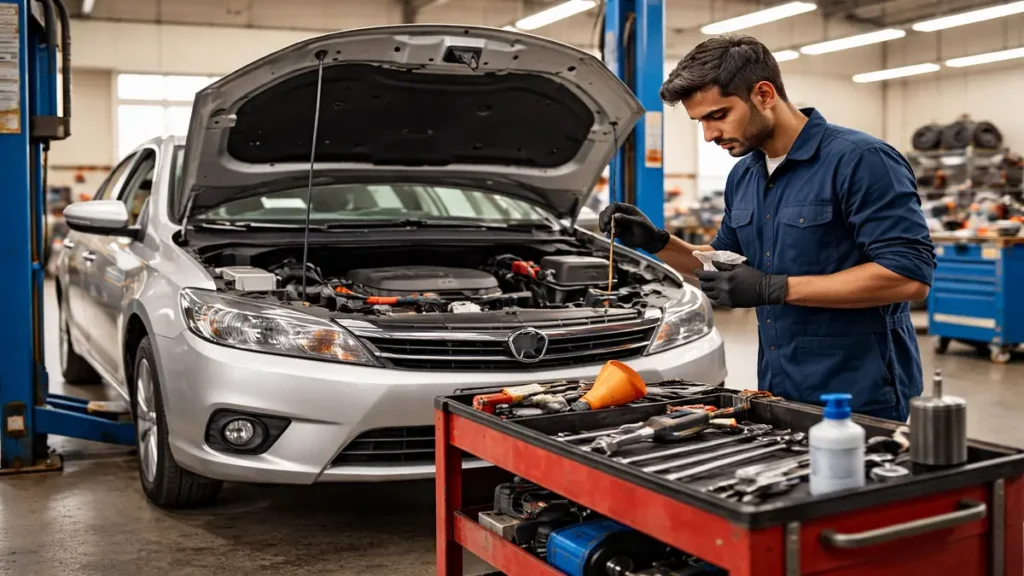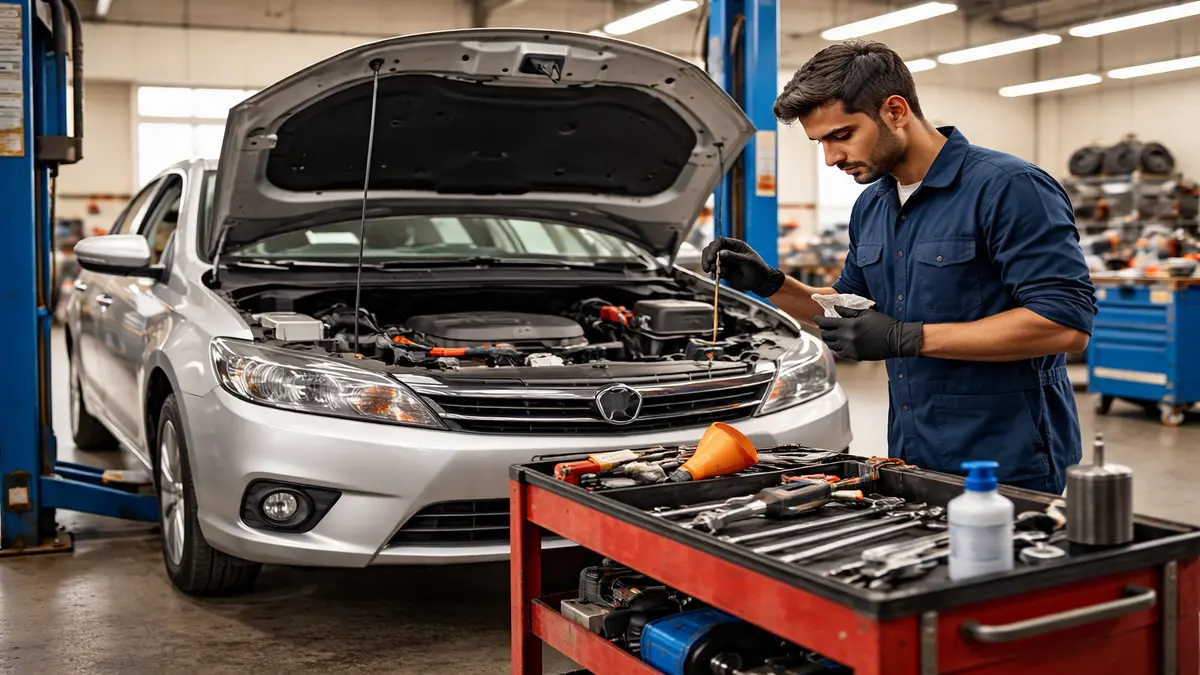
Learn car service interval in India with a complete schedule, what to replace, service cost, comparison table, common mistakes to avoid and FAQs.
Hello friends, hope you’re doing well today.
If you own a car in India, you already know one thing—running a car is not just about petrol or diesel. The real secret of keeping a car smooth and problem-free is timely servicing. Many of us delay service because the car “feels fine,” but later we end up spending more money on repairs.
That’s why in this article I’ll explain car service intervals in India in a very simple way—when to service, what gets checked, what mistakes people usually make, and how you can save money in the long run. So friend, let’s understand it like normal people do, without any confusing technical words.
What is a Car Service Interval in India (simple meaning)
A service interval means the gap between two services. It can be:
- based on kilometres (example: every 10,000 km)
- based on time (example: every 6 months)
- whichever comes first
In India, most car companies follow something like:
- 10,000 km or 12 months (common in new cars)
- 15,000 km or 12 months (some brands)
- 5,000 km or 6 months (some older engines / harsh usage)
If you drive less, time-based service matters.
If you drive more, km-based service matters.
Why service interval matters more in India (reality check)
In foreign countries, roads are smooth, fuel quality is consistent, and traffic is less chaotic.
India is different.
Here we face:
- stop-go traffic
- dust and pollution
- rough roads
- waterlogging in monsoon
- high heat in summers
- long idling with AC
All these conditions make engine oil, air filter, brakes, and suspension wear faster.
So friend lets know something more interesting fact or feature—
In Indian city traffic, your car may run only 25 km, but the engine might be ON for 2 hours. That’s why service intervals based only on km are sometimes misleading.
Standard car service interval in India (most common)
Here is the most practical rule you can follow:
For most modern petrol cars
- Every 10,000 km or 12 months
For most modern diesel cars
- Every 10,000 km or 12 months
(Some diesel engines: 15,000 km depending on brand)
For CNG cars
- Every 8,000–10,000 km
(CNG burns cleaner but runs hotter, spark plugs and valves matter)
For turbo petrol engines
- Every 8,000–10,000 km
Turbo engines are sensitive to oil quality.
For old cars (5+ years) or heavy usage
- Every 7,000–8,000 km
Or twice a year.
First service, second service, third service (new car service schedule)
Most car brands in India follow a pattern like:
- First service: 1 month / 1,000–1,500 km
- Second service: 6 months / 5,000–7,500 km
- Third service: 12 months / 10,000–15,000 km
- Then yearly / 10,000 km cycle
The early services are to:
- check initial wear
- tighten fittings
- inspect fluids
- inspect tyres
- ensure there are no manufacturing-related issues
The biggest confusion: “Do I really need service if I don’t drive much?”
Yes.
Even if you drive less than 5,000 km a year:
- engine oil still degrades with time
- moisture can build in oil
- fuel quality degrades
- rubber parts age
- battery weakens
So brother, time-based service is important.
What happens in a proper car service (not just oil change)
A proper service includes:
Engine system
- engine oil change
- oil filter change
- air filter inspection/replacement
- fuel filter (some schedule)
- spark plug check (petrol)
Cooling system
- coolant level and leak check
- radiator and hoses
Brakes
- brake pad thickness
- brake fluid check
- brake cleaning (important)
Suspension and steering
- ball joints check
- bushes check
- noise inspection
Tyres
- tyre rotation
- tyre pressure
- wheel alignment check
Electrical
- battery health check
- lights check
- wiper check
A “cheap service” that ignores checks becomes expensive later.
Service intervals for different usage types (this is the real part)
Not everyone drives the same way. Your interval should match your use.
If you mostly drive in heavy city traffic (Patna/Delhi/Mumbai style)
Recommended interval:
- every 8,000–10,000 km
- every 6 months if traffic is extreme
Because:
- more idling
- more heat
- more brake wear
- clutch stress (manual cars)
If you drive mostly highway
Recommended interval:
- 10,000–15,000 km
The highway is actually easy on the engine.
If you drive short trips daily (2–5 km)
Recommended interval:
- every 6 months
Short trips cause more engine wear because oil doesn’t heat fully.
If you drive in dusty rural roads
Recommended interval:
- air filter earlier
Dust kills mileage and engine breathing.
And yes friend… Do you know it’s very special or unique?
The air filter is one of the cheapest parts but ignoring it can drop mileage badly and even damage the engine slowly.
Car service interval comparison table (India)
Here is a simple table you can follow:
| Car Type | Normal Service Interval | Indian Harsh Condition Interval | Key Extra Focus |
| Petrol NA engine | 10,000 km / 12 months | 8,000 km / 6–12 months | oil + air filter |
| Petrol Turbo | 10,000 km / 12 months | 7,500–10,000 km | oil quality critical |
| Diesel | 10,000–15,000 km / 12 months | 10,000 km | fuel filter, turbo |
| CNG | 10,000 km / 12 months | 8,000–10,000 km | spark plugs, valve health |
| Automatic gearbox car | same as engine | same as engine | ATF service schedule |
| EV (electric car) | 1 year check | 6–12 months | tyres, brakes, coolant |
What to replace at what interval (practical schedule)
This section saves money.
Every service (6–12 months)
- engine oil
- oil filter (most cases)
- general inspection
- brake check
- tyre pressure
Every 10,000–20,000 km
- air filter (earlier in dusty areas)
- cabin AC filter
Every 20,000–40,000 km
- brake pads (depends on driving)
- wheel alignment + balancing
Every 40,000–60,000 km
- spark plugs (depends on type)
- coolant replacement (brand schedule)
- brake fluid replacement
Every 60,000–100,000 km
- suspension parts depending on roads
- clutch (manual, depends on driving)
Automatic car service intervals (AT/CVT/AMT/DCT)
Many people ignore gearbox service. That’s expensive later.
General rule
- Check ATF/CVT fluid around 40,000–60,000 km (many brands)
- Some DCT gearboxes need more careful schedule
If your automatic car starts showing:
- jerks
- delayed shift
- heating
Don’t ignore it.
So brother, gearbox repair is costly. Prevention is cheaper.
Read More
Hyundai Loniq 6 Review: Stylish, Futuristic & Fully Electric Car in India
Kia EV9 Review 2025 – Specs, Price, Range & Global Market Insights
Kia EV3 – The Compact Electric SUV Redefining Affordable EV Mobility
AC service interval (very important in India)
Indian summers make AC work like a machine.
Recommended:
- AC filter replacement every 10,000–15,000 km
- AC gas top-up only if needed
- cleaning evaporator if smell comes
If AC becomes weak, many people blame gas only. But often:
- filter is choked
- condenser is dirty
- blower has dust
Service interval for cars under 3 years (warranty period)
In the warranty period, follow the company schedule strictly.
Because:
- missing service can void warranty
- service record matters if big issue happens
- resale value improves with service history
“Authorized service center vs local garage” (honest POV)
This is a common debate.
Authorized service center is best for:
- new car (warranty period)
- complex electronic issues
- engine management problems
- parts replacement under warranty
Local garage is fine for:
- basic oil change
- brake pad replacement
- suspension work (if trusted mechanic)
- old cars
My suggestion:
If car is new → service at company center
If car is 5+ years old → trusted garage can save money
But never compromise on:
- engine oil quality
- filters
- brake work
Common service mistakes people do in India (avoid these)
Now friend, these mistakes are super common:
Skipping service because “car is running fine”
The car doesn’t warn before damage. Oil becomes poor quietly.
Using cheap engine oil
Cheap oil feels safe today, but costs later.
Ignoring air filter
Dust kills mileage and throttle response.
Ignoring brake cleaning
Brake noise starts, and then the pad and disc both get damaged.
Only doing “general service”
Service should be preventive, not just washing.
Delaying coolant and brake fluid change
These fluids age with time.
And yes friend… Do you know it’s very special or unique?
Brake fluid absorbs moisture over time. Old brake fluid can reduce braking performance even if pads are new.
Real story (ownership POV)
Let me share a real type of story.
One known person in my area had a petrol hatchback. He used it mainly for:
- school drop
- market
- small trips
He drove only 4,000–5,000 km a year. So he thought:
“Why service? The car runs fine.”
He skipped yearly oil changes.
After 3 years:
- engine started making noise
- mileage dropped
- smoke on cold start
The mechanic opened and found sludge in oil.
His repair bill became much higher than the cost of 3 regular services.
This is the truth.
Service is not a waste. Service is protection.
Service cost expectations in India (basic idea)
Service cost varies by brand and engine.
Typical ranges:
- Small hatchback petrol: ₹2,000–₹6,000
- Sedan/SUV petrol: ₹4,000–₹10,000
- Diesel cars: ₹5,000–₹12,000
- Luxury brands: very high
Oil type matters:
- mineral oil cheaper
- semi-synthetic medium
- fully synthetic best but expensive
For turbo engines, synthetic oil is better.
Car service interval FAQs (very useful)
What is the ideal car service interval in India?
For most cars: 10,000 km or 12 months. In harsh city traffic: 8,000 km is better.
Is it okay to service once a year only?
Yes, if you drive less. But don’t skip yearly service even if km is low.
Is oil change necessary if I drove only 3,000 km?
Yes, once a year minimum.
Does service interval differ for diesel?
Mostly similar, but diesel fuel filters and turbo checks matter more.
What happens if I miss service by 2–3 months?
Usually nothing immediate, but repeated delays reduce engine life.
When to replace air filters in India?
Every 10,000–15,000 km, earlier if dusty environment.
When to replace brake fluid?
Usually every 2 years.
When to replace coolant?
Usually every 2–5 years, depending on coolant type and brand schedule.
Does car service improve mileage?
Yes, a clean air filter + good oil can improve mileage noticeably.
Is wheel alignment part of service?
Not always. Do alignment every 10,000 km or when steering pulls.
Can I service the car at the local garage without losing warranty?
During warranty, it is better to use authorized centers. After warranty, the local garage is fine.
Should I serve before a long trip?
Yes. At least check:
- oil level
- tyre pressure
- brake pads
- coolant
Service interval for automatic cars?
Same engine service interval, plus gearbox fluid schedule (often 40k–60k).
What if my car is parked for months?
Do service once a year. Also check battery and tyre flat spots.
Final conclusion (simple and honest)
So friends, if you remember only one thing from this guide, remember this:
Car service is not a cost. It is insurance for your engine and your safety.
In India, the best practical service interval rule is:
- Every 10,000 km or 12 months
- Every 8,000 km if your driving is harsh city traffic
- Never skip oil change yearly
So brother, if you service on time, your car will give you:
- better mileage
- smoother drive
- fewer breakdowns
- better resale value