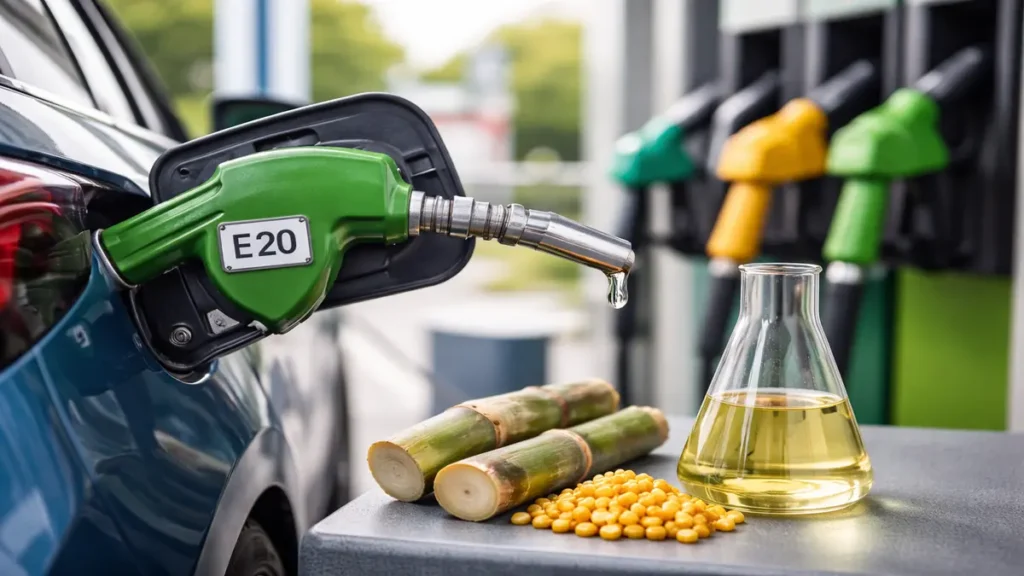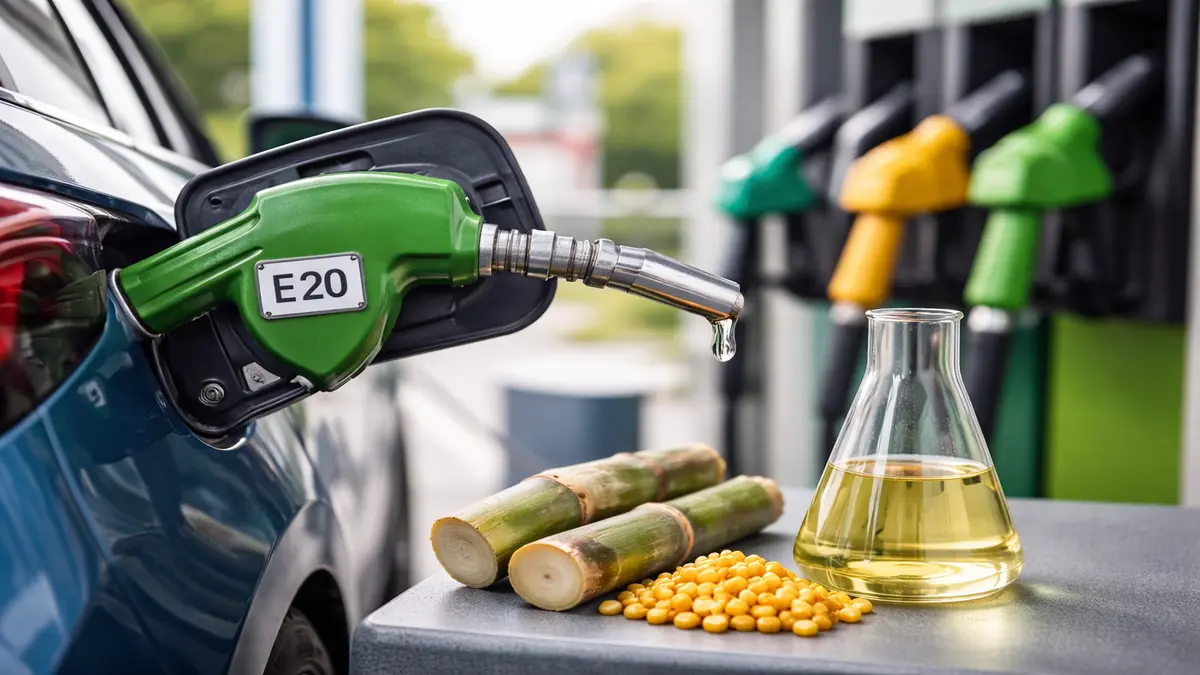
India achieves 20% ethanol blending target ahead of schedule. Learn what E20 means, benefits, mileage impact, vehicle compatibility, myths and FAQs.
Why ethanol blending matters more than it looks
Some people think:
“Okay, the government achieved its target… but why should I care?”
Because it changes:
- what you put in your tank
- how your vehicle behaves
- how much petrol India imports
- how fuel economy works in daily life
- how farmers and rural economy benefit
You may not feel it in one day, but over time, this becomes a big shift.
India Achieves 20% Ethanol Blending E20 in daily life: how you will actually notice it
Let’s talk like normal riders.
You might notice:
- mileage slightly lower (in some cases)
- cold start feel slightly different (rare cases)
- fuel smell changes slightly (some people say this)
- engine response difference in older vehicles
But for most people:
- life continues normally
- you just need better maintenance discipline
So brother, E20 is not a “fear topic.” It’s a “be aware and maintain” topic.
E20 vs E10 vs Normal Petrol: simple comparison
Now friend, this table will clear confusion quickly.
Comparison Table: E0 vs E10 vs E20
| Fuel Type | Ethanol % | Petrol % | Common Name | Main Meaning |
| E0 | 0% | 100% | Normal Petrol | Pure petrol |
| E10 | 10% | 90% | Ethanol blended petrol | Moderate blend |
| E20 | 20% | 80% | Higher ethanol blend | Stronger blend |
What changes as ethanol increases?
- energy content reduces slightly
- octane effect changes
- moisture absorption increases
- compatibility importance increases
Why ethanol is blended: the “real India reason”
The strongest reasons are:
Reduce crude oil import dependency
India imports a big part of crude oil. E20 reduces petrol usage slightly, which reduces import pressure.
Keep fuel money inside India
Ethanol is produced locally. This keeps economic activity inside the country.
Support farmers and rural industry
Demand for ethanol means demand for feedstock. This creates income cycles in rural India.
Fuel security in global crisis
When global crude prices jump, India suffers. E20 gives a cushion.
So friends… Do you know it’s very special or unique?
India is using local agriculture to partially power transport. That’s a big structural shift.
Ethanol source: from where does India get ethanol?
This is important because people often think only sugarcane is used.
Ethanol can come from:
- sugarcane molasses (very common)
- sugarcane juice/syrup (in some cases)
- maize (corn)
- surplus grains
- damaged grains (unfit for human consumption)
- other biomass sources (in developing phase)
Why multiple sources matter
If ethanol comes from only one crop:
- supply becomes unstable
- price becomes volatile
- environmental pressure increases
Diversification is necessary for long-term success.
Food vs fuel debate (honest discussion)
Now let’s not hide this debate.
Some people ask:
“Why use grains for fuel when food prices are rising?”
That’s a valid concern.
Supporters say:
- only surplus/damaged grains are used
- farmers benefit
- rural economy benefits
- oil import reduces
Critics say:
- it can push crop price up
- it can influence farming pattern
- poor people can feel food inflation
Truth:
The programme must be balanced carefully
Transparency about feedstock is important
Food security cannot be compromised
Water concern: sugarcane and sustainability
Sugarcane is water intensive.
If ethanol demand pushes more sugarcane cultivation:
- water stress increases in some states
- groundwater pressure increases
That’s why grain-based and multi-feedstock ethanol is important.
So brother, E20 success is not only about “blending.” It’s about sustainable supply.
Impact on vehicle performance: what changes with E20?
This section matters most for riders and car owners.
Ethanol has lower energy per litre
So the engine may need slightly more fuel for the same work.
Ethanol has higher oxygen content
It burns differently.
Ethanol can attract moisture
This matters for storage and older vehicle components.
Now the important part:
E20 is not a poison. It’s just a different fuel mix.
Newer vehicles can handle it better.
E20 effect on mileage: practical and realistic
Mileage effect depends on:
- vehicle type
- engine condition
- fuel system design
- driving pattern
Normal real-life mileage impact
- some vehicles: 2–5% drop
- older vehicles: can feel more
- E20-ready vehicles: less noticeable
But don’t forget:
Many people blame fuel when real reason is:
- low tyre pressure
- dirty air filter
- old spark plugs
- heavy traffic
So friend lets know something more interesting fact or feature—
Sometimes E20 doesn’t reduce mileage much. It just exposes maintenance issues faster.
Vehicle compatibility: E20-ready vs older vehicles
E20-ready vehicles
These are designed with:
- ethanol-resistant rubber seals
- compatible fuel lines
- updated ECU tuning
- better injectors/materials
Older vehicles
Older bikes/cars may have:
- rubber parts that degrade earlier
- older fuel hose material
- carburetor parts sensitive to ethanol (some bikes)
But let me be clear:
Most older vehicles will still run. Just:
- monitor
- maintain
- don’t ignore fuel smell and leaks
E20 and motorcycles: special focus
Motorcycles in India are huge in number. Many are older.
New bikes
Newer BS6 bikes are generally more compatible.
Old carburetor bikes
Older carb bikes may face:
- slightly different tuning need
- rubber line issues over time
- storage issues if parked for long
What you should do for older bikes
- use bike regularly (avoid long parking)
- don’t store fuel for months
- service regularly
- replace old fuel pipes if needed
E20 and cars: what owners should know
Modern cars (last 3–5 years)
Mostly fine, especially if the manufacturer says E20 compliant.
Older cars (7–12 years)
Be careful with:
- fuel lines
- seals
- fuel pump health
- clogged injectors (rare)
- maintenance schedule
Maintenance checklist after E20 shift (very practical)
This is the most useful part.
For bike owners
- check tyre pressure weekly
- service every 3,000–4,000 km
- keep air filter clean
- check spark plug condition
- check fuel pipe (especially old bikes)
For car owners
- service on time
- replace air filter regularly
- change spark plugs as per schedule
- keep fuel injectors clean (if recommended)
- avoid low quality fuel pumps
Big table: what to do if you notice issues after E20
| Symptom | What it might mean | What to do |
| Mileage drop | fuel + maintenance | check air filter, tyre pressure, plug |
| Hard starting (old vehicle) | plug/ fuel line | check plug, fuel pipe, service |
| Fuel smell | leak possibility | inspect fuel hose, seals |
| Rough idle | tuning issue | service + injector/carb cleaning |
| Knocking sound | fuel quality/engine issue | use better quality fuel pump, check engine |
This table can save people from panic.
Myth vs Fact (important)
Many wrong ideas are spreading.
Myth 1: E20 will destroy engines
Fact: E20 is used in many places globally. Engines don’t “destroy” suddenly. Compatibility matters mainly for older vehicles.
Myth 2: E20 is fake petrol
Fact: Ethanol blending is a legitimate fuel strategy, not adulteration.
Myth 3: Mileage will drop by 20%
Fact: Mileage drop is not equal to blending %. Usually small drops.
Myth 4: E20 is only for cars, bikes will fail
Fact: Bikes can run too, but older bikes may need better maintenance.
Myth 5: E20 increases engine heat dangerously
Fact: In normal riding, no major issue for a healthy engine.
So friends… Do you know it’s very special or unique?
E20 is not dangerous. Misinformation is dangerous.
Pros and Cons table (balanced view)
E20 Pros and Cons
| Pros | Cons / Concerns |
| reduces crude import dependency | mileage may drop slightly |
| supports farmers and rural economy | old vehicle compatibility issues |
| local fuel production | storage/moisture sensitivity |
| better fuel security | sugarcane water stress debate |
| can reduce some emissions | food vs fuel discussion |
Balanced understanding is best.
Ethanol blending and fuel price: will petrol become cheaper?
This is tricky.
Some people believe E20 will reduce petrol prices. In reality:
- petrol price depends on crude oil price
- taxes
- logistics
- ethanol procurement price
- market policy
So E20 may not instantly make petrol cheaper at the pump. But it helps the country:
- reduce import pressure
- manage energy risk
In the long term, that can support stability.
E20 and engine power: will my bike feel weak?
Most likely no, but some riders feel:
- slightly lower pickup
- mostly in older vehicles
- mostly when engine already needs servicing
If you maintain the bike properly, the difference is small.
A real-life cost example (simple math)
Let’s do a normal monthly scenario.
Assume a bike rider:
- rides 900 km/month
- mileage earlier 60 km/l
- now mileage 57 km/l
Fuel used earlier:
900/60 = 15 litres
Fuel used now:
900/57 = 15.79 litres
Extra fuel = 0.79 litre/month
At ₹105/litre:
Extra cost ~ ₹83/month
This is not “huge,” but it feels noticeable for budget riders.
So brother, that’s why communication and transparency matter.
What government and companies must ensure (for smooth transition)
For E20 to succeed without public anger:
- clear labeling at pumps
- steady quality checks
- E20 availability without confusion
- public awareness about compatibility
- support for older vehicle owners
Without this, people will blame E20 for everything.
Is E20 safe for long trips?
Yes, but:
- fill from trusted pumps
- don’t keep tank low too often
- maintain air filter and tyre pressure
On the highway, mileage variation may be less noticeable because traffic is smoother.
What happens next after E20?
Most likely next steps are:
- making E20 availability stable nationwide
- increasing E20-ready vehicles
- flex-fuel planning (future idea)
E30/E85 type future requires:
- major vehicle tech shift
- stronger infrastructure
So don’t worry about that now.
Related Post
Yamaha MT-15 V2 (2025) – The Street Fighter That Rules the Roads!
Hero Vida VX2 Electric Scooter
Suzuki Burgman Hydrogen Scooter 2025:200 KM Range & Eco Power
Kawasaki Ninja H2R – The Beast That Breaks All Limits
All BMW Bike Models, Price, Images, Specs
Big FAQ Section (detailed and practical)
General FAQs
What does E20 mean?
E20 means petrol blended with 20% ethanol and 80% petrol.
Why does India mix ethanol in petrol?
To reduce crude import dependency, increase local fuel production, and support agriculture.
Is ethanol the same as alcohol?
Yes, ethanol is alcohol-based fuel, but used as fuel after processing.
Is E20 petrol safe?
Yes for most vehicles, especially newer ones. Older vehicles should be maintained carefully.
Will E20 replace all petrol completely?
Over time E20 becomes common, but transition depends on policy and distribution.
Mileage and performance FAQs
Will mileage drop with E20?
It can drop slightly (usually a few %), depending on vehicle and condition.
Will pickup become weak?
Most modern vehicles: no noticeable change. Older ones: slight change possible.
Does ethanol increase engine heat?
In normal conditions, not a major issue for a healthy engine.
Should I change my riding style?
No, but calm riding and good maintenance helps.
Will E20 increase maintenance cost?
Not necessarily. But old vehicles might need fuel hose/seal replacement earlier.
Vehicle compatibility FAQs
My bike is 10 years old. Is E20 safe?
It will likely run, but check fuel hoses and do regular servicing.
Will E20 damage carburetor bikes?
Not instantly. But long storage and old rubber parts can create issues over time.
Are new cars E20-ready?
Many are moving towards E20-ready. Check vehicle manual or manufacturer guidance.
Do I need to change engine oil because of E20?
No special oil change is required. Just follow the normal service schedule.
Will E20 harm fuel injectors?
Modern injectors can handle it. Poor fuel quality and dirty filters are bigger issues.
Fuel storage FAQs
Can I store E20 petrol at home?
Not recommended. Petrol storage is risky and not safe.
If my bike stays parked for months, what should I do?
Avoid leaving old fuel for long. Start and run the bike periodically or consult a mechanic.
Does ethanol attract water?
Yes, ethanol can absorb moisture more than pure petrol.
Is E20 bad during the rainy season?
Not really, but avoid water contamination by using trusted fuel stations.
Economic and national impact FAQs
Will E20 reduce petrol prices?
Not directly. But it can support long-term energy security and stability.
Will E20 reduce crude oil imports?
Yes, partially, by reducing petrol requirements.
How does ethanol help farmers?
It creates additional demand for crop-based raw material, supporting rural income.
Is there a food vs fuel problem?
There is debate. Balance and transparent feedstock policy matters.
Is ethanol blending good for the environment?
It can help reduce fossil fuel usage, but production side sustainability matters too.
Practical FAQs for normal people
Should I stop using my old car because of E20?
No. Just maintain it properly and check the fuel line condition.
How to reduce mileage loss with E20?
- correct tyre pressure
- clean air filter
- proper servicing
- smooth driving
Which vehicles will face more issues?
Older vehicles with old fuel hoses/seals and poor maintenance.
Can I choose E10 instead of E20?
Depends on availability. Many places may supply blended petrol based on target.
How do I know if I’m filling E20?
Some pumps show labeling. Otherwise many people don’t notice.
What is the biggest mistake people make during the E20 shift?
Blaming E20 for all issues and skipping maintenance.
Deep technical-but-simple FAQs
Does ethanol change octane?
Ethanol generally has high octane characteristics, but overall blend behavior depends on base petrol.
Does E20 increase corrosion risk?
Old materials can corrode faster with moisture risk. Modern materials resist better.
Do I need to change the fuel filter more often?
Not required in normal cases. But if the vehicle feels rough, the service center may recommend checks.
Will E20 affect catalytic converters?
No major direct damage in normal vehicles.
Does E20 burn cleaner?
It can reduce some tailpipe emissions, but the full lifecycle depends on production.
Final conclusion (long but simple)
So friends, India achieving 20% ethanol blending (E20) ahead of schedule is a major national step. It shows strong planning, supply chain work, and policy push.
But at human level, it means:
- petrol is changing
- mileage may change slightly
- old vehicles need better maintenance
- farmers get extra market
- India reduces some import pressure
And yes friend… Do you know it’s very special or unique?
Because E20 is one of those changes where a national decision enters your daily life quietly—through the fuel tank.
If you maintain your vehicle well and stay aware, you won’t have any stress.