
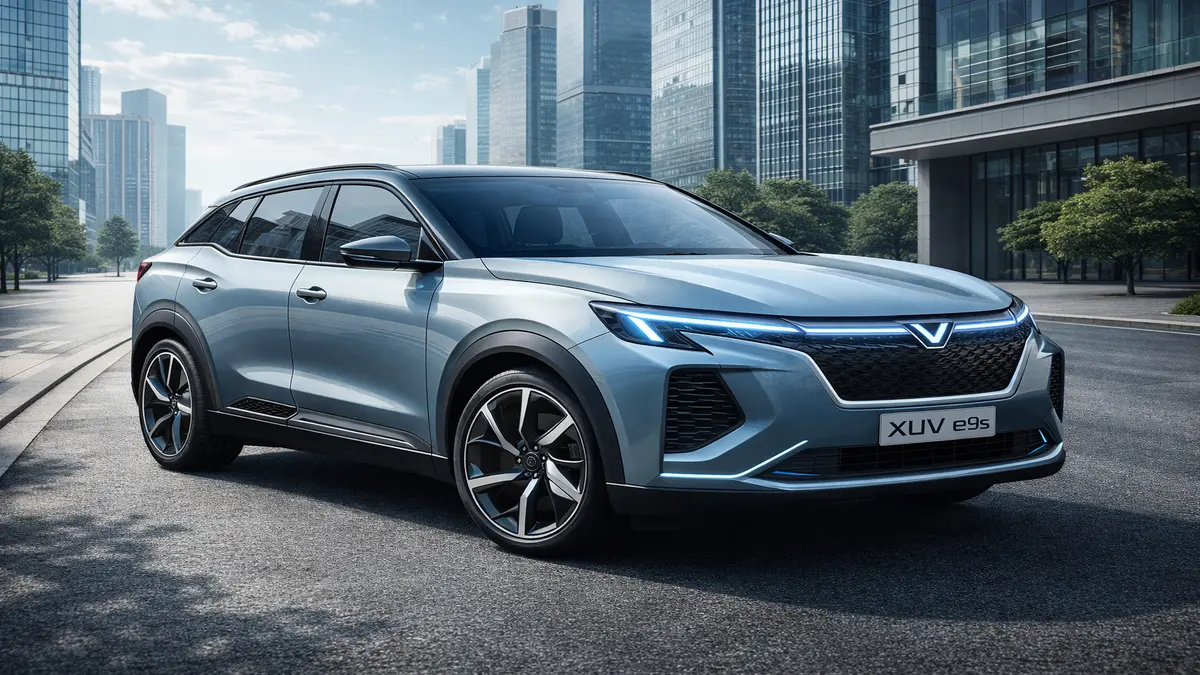
Mahindra XEV 9S electric SUV review with expected price, range, features, charging details, and launch update in India. Full specs & real POV.
Introduction: Finally, A Proper 7-Seater Electric SUV That Doesn’t Feel Like a “Compromise”
Let me be honest—India was missing something important in the EV space.
We had electric hatchbacks. We had electric compact SUVs. We had some premium electric SUVs that looked amazing but were priced like luxury apartments.
But we didn’t have a mass-market 7-seater EV SUV that felt like it was built for Indian families. Not just “technically 7 seats,” but a car that actually understands why people buy 7-seaters in the first place—family trips, elders, kids, luggage, and that one extra cousin who always joins at the last minute.
That’s why the Mahindra XEV 9S has created a genuine buzz. It isn’t trying to be cute. It isn’t trying to be a small EV pretending to be big. It’s a proper SUV-style EV designed around space, range, comfort, and tech—basically everything modern buyers want.
And the best part? It’s not priced in a “dream only” range. It actually starts around ₹19.95 lakh (ex-showroom) and goes up to ₹29.45 lakh (ex-showroom) depending on variant and battery pack.
In this article, we’ll cover the Mahindra XEV 9S in full depth:
- price & variants
- battery options and real range expectations
- charging experience
- interiors & 7-seat practicality
- features and tech
- performance
- safety
- ownership costs
- comparison with rivals
- FAQs that real buyers ask (not fake ones)
So if you’re thinking about buying a premium electric family SUV in 2026, this guide will clear your mind.
Quick Snapshot: What Is the Mahindra XEV 9S?
The Mahindra XEV 9S is a 7-seater electric SUV built on Mahindra’s INGLO electric platform, which is designed specifically for EVs (not a modified petrol platform). That’s important because EV-first platforms usually deliver better:
- interior space
- battery packaging
- stability
- charging capability
- long-term scalability
Mahindra positioned Mahindra XEV 9S as a family-friendly electric SUV with:
- multiple battery choices (59 kWh, 70 kWh, 79 kWh)
- long ARAI claimed range (up to around 679 km depending on variant)
- premium cabin with multiple screens
- strong performance (the top versions are seriously quick)
- modern safety features including ADAS (depending on variant)
Mahindra XEV 9S Price in India (Ex-Showroom)
Let’s start with the question everyone asks first.
Price Range:
₹19.95 lakh to ₹29.45 lakh (ex-showroom)
This price range matters because it places the Mahindra XEV 9S between:
- upper mid SUV segment
- premium SUV segment
- and just below luxury EV SUVs
In simple words: it’s expensive, yes, but it’s not “unreachable expensive.”
Real On-Road Pricing (Practical Expectation)
Depending on your state EV road tax rules, insurance, and registration benefits, the on-road price can vary a lot.
In many cities, you should expect:
- Base on-road: roughly ₹22–₹24 lakh
- Top on-road: roughly ₹32–₹35+ lakh
If you’re buying the top model, your insurance premium alone will remind you this is not a “small purchase.”
Variants & Battery Options: How Mahindra Has Structured It
Mahindra has offered Mahindra XEV 9S in multiple variants and with three battery options.
Battery Options:
- 59 kWh
- 70 kWh
- 79 kWh
Claimed Range (ARAI-type figures)
- 59 kWh: ~521 km
- 70 kWh: ~600 km
- 79 kWh: ~679 km
Now, I’ll say something very honestly:
ARAI range is like “mileage shown on brochure”—it’s great for comparison, but your reality will depend on:
- speed
- AC usage
- driving style
- load (7 people + luggage)
- tyre pressure
- city vs highway mix
We’ll talk about real-world range later.
Design & Road Presence: It Looks Big, And That’s The Point
When you first see the Mahindra XEV 9S, the vibe is clear:
This is not a shy car.
It has that strong Mahindra SUV personality:
- wide stance
- SUV height
- bold front design
- futuristic EV elements
What I like about it
Mahindra didn’t overdo the “EV spaceship” styling.
Yes, it looks modern, but it still looks like an SUV that belongs on Indian roads. That’s important. Many EVs look too “concept-car-ish” and then people get bored after 6 months. The Mahindra XEV 9S has a more mature style.
What some people may dislike
Some buyers prefer “clean European style.”
If you’re that type, you may find it a little too bold.
But family SUV buyers in India generally love bold.
Interior: This Is Where Mahindra XEV 9S Is Trying To Win Hard
Inside the cabin, the Mahindra XEV 9S clearly aims for a modern premium experience.
Dashboard & Screens
Depending on the variant, you get a premium setup with:
- big digital driver display
- large infotainment screen
- and a third screen layout in higher variants (Mahindra is going heavy on screens)
Now people have mixed feelings about too many screens, but one thing is sure:
when someone sits in the car, they instantly feel it’s expensive.
Cabin Feel
The cabin is designed to feel:
- wide
- open
- premium
If Mahindra has worked on fit/finish properly (which is improving year by year), then Mahindra XEV 9S can genuinely feel like a segment leader inside.
Seating & Space: The Real 7-Seater Test
Here comes the make-or-break factor.
Because in India, 7-seater buyers don’t want a “5+2 tiny seats” car. They want something usable.
Row 1 (Front seats)
Expected experience:
- supportive seats
- good visibility
- ventilated seats in higher variants
Row 2 (Middle seats)
This is where most family comfort lives. For 7-seaters, row 2 must feel like the main comfort zone, not a compromise.
What to check:
- thigh support
- under-thigh comfort
- recline angle
- sliding function (if offered)
- AC vents and charging points
Row 3 (Third row)
Let’s be realistic:
Third rows are almost never “sofa comfort.”
But a good 7-seater should offer:
- usable headroom
- decent knee room (with row 2 adjusted)
- AC vents
- acceptable seating angle
If the Mahindra XEV 9S delivers a decent third row, it becomes a real family EV. If not, it becomes a “mostly 5-seater with emergency seats.”
Boot Space: The Real Family Trip Problem
7 seats up = boot is small
That’s the rule of physics.
So you should look at it this way:
- With 7 seats up: limited luggage, mostly bags
- With 5 seats up: good boot space
- With 2 seats up: huge boot space
Many families will travel as 4–5 people most of the time, so the boot should be fine.
Performance: This SUV Will Surprise Many People
A lot of people still think EVs are “slow and boring.”
That’s outdated thinking.
The Mahindra XEV 9S in higher variants gets strong motor output:
- up to 210 kW
- around 282 bhp
- 380 Nm torque
That torque figure matters because in EVs torque comes instantly.
So overtakes feel effortless.
City driving feels smooth.
Even with 7 passengers, EV torque makes it feel lighter than it actually is.
Driving feel expectation
- calm when you want
- quick when you push
- smooth in stop-and-go traffic
- silent cabin (big EV advantage for family)
If you’ve driven diesel 7-seaters, you’ll immediately feel the difference: no vibration, no engine noise, no gear changes.
Battery & Range: The Most Important Section (Read This Carefully)
Let’s discuss range like real people do.
Real-world range expectation (approx.)
These are practical estimates depending on AC, traffic, load, and speed.
59 kWh
- City: ~380–450 km
- Highway: ~280–360 km
70 kWh
- City: ~450–520 km
- Highway: ~340–420 km
79 kWh
- City: ~520–600 km
- Highway: ~400–480 km
Again, these are not promises—just realistic expectations based on how EV range usually drops on highways at higher speed.
My honest recommendation
If your budget allows, choose the bigger battery.
Why?
Because bigger battery gives:
- more peace of mind
- less charging stress
- stronger resale value
- better trip flexibility
Charging: Home Charging vs Fast Charging Reality
EV ownership depends on charging convenience.
Home charging (best case)
If you can install a home charger, life becomes easy.
Typical routine:
- you plug at night
- wake up with full charge
- drive without thinking
That’s the EV “dream life.”
Public charging (realistic case)
India’s charging network is improving, but it still requires planning.
For long trips, what matters:
- fast charger availability
- charger working or not
- queue at charging station
- payment and app issues
This is improving, but in 2026, it’s still not as smooth as petrol.
Fast charging
The Mahindra XEV 9S supports fast charging and should be capable of good charging speeds (depending on charger capacity).
Real-world fast charge behavior usually looks like:
- 10% to 80% in around 30–45 minutes (varies)
This is enough to:
- grab tea
- use washroom
- stretch
- continue trip
Features: What You’re Actually Paying For
A lot of the price is justified by features and tech.
Expected key features (variant dependent):
- premium infotainment
- connected car tech
- wireless Apple CarPlay / Android Auto
- ventilated seats
- panoramic sunroof
- multi-zone climate
- 360-degree camera
- premium audio
- multiple airbags
- ADAS Level 2 (in top variants)
ADAS: Good, But Use With Brain
ADAS is great but don’t treat it like autopilot.
It’s driver-assist, not driver-replacement.
In Indian traffic, ADAS is helpful mostly on highways.
Safety: This Matters More in a Family SUV
When spending 20–30 lakh, safety is non-negotiable.
Features you should prioritize:
- 6+ airbags (some variants offer 7)
- ESC (electronic stability control)
- traction control
- hill hold and hill descent
- ISOFIX
- strong body structure
- 360 camera
If ADAS is included, even better.
Maintenance Cost & Ownership: EV Advantage Here
EVs have fewer moving parts than ICE vehicles.
So:
- no engine oil
- no clutch
- no gearbox complexity
- no exhaust system issues
Expected maintenance:
- brake pads (EV regen braking reduces wear)
- tyres (EV torque wears tyres faster)
- suspension work over time
- battery cooling system checks
Running cost
Electricity cost per km is usually far cheaper than petrol/diesel.
If you charge at home, the cost per km can feel almost unbelievable at first.
Many new EV owners say:
“Yaar, petrol wali gaadi me itna paisa jalta tha.”
That feeling is real.
Read More
Hyundai Loniq 6 Review: Stylish, Futuristic & Fully Electric Car in India
Kia EV9 Review 2025 – Specs, Price, Range & Global Market Insights
Kia EV3 – The Compact Electric SUV Redefining Affordable EV Mobility
Who Should Buy the Mahindra XEV 9S?
You should seriously consider XEV 9S if:
- you want a 7-seater EV (real family use)
- you drive mainly city + some highway
- you have home charging
- you want premium tech + modern cabin
- you want a future-ready car for 5–7 years
You should avoid / rethink if:
- you don’t have home charging and no reliable public chargers nearby
- you do frequent long highway trips every week
- you want a low-maintenance petrol/diesel simplicity
- your budget is stretched too tight
Comparison Table: Mahindra XEV 9S vs Rivals (EV + Nearby Segment)
Here’s a clean comparison for your blog.
| Model | Seating | Battery/Power | Claimed Range | Price Range | Best For | Weak Point |
| Mahindra XEV 9S | 7 | 59/70/79 kWh | up to ~679 km | ₹19.95–₹29.45 L | family 7-seat EV | charging infra depends |
| Tata Safari (Diesel) | 7 | Diesel | N/A | similar | highway touring | fuel cost + diesel feel |
| Hyundai Alcazar | 6/7 | Petrol/Diesel | N/A | similar | comfort | not EV tech |
| BYD Atto 3 | 5 | EV | strong | higher | premium EV | not 7-seater |
| MG ZS EV | 5 | EV | decent | similar | city comfort | not 7-seater |
| Tata Harrier EV (expected segment) | 5 | EV | expected good | similar/higher | performance EV | not 7-seater |
This table makes one thing obvious:
XEV 9S stands out mainly because it’s a 7-seater EV.
Real Experience Section: How It Feels to Live With a Big EV SUV
Let me tell you something many EV owners experience.
The first week of EV ownership is exciting.
The second week is confusing.
The third week is confidence.
Because EV driving changes habits.
What you’ll love
- silent cabin
- instant pickup
- smooth driving
- cheap running cost
- modern screen-based cabin feel
What you’ll take time to adjust to
- charging planning
- range anxiety (it reduces with experience)
- public charger reliability
- learning to drive efficiently (optional but helpful)
Once you get used to it, EV ownership feels calmer than ICE ownership.
You stop visiting petrol pumps.
You stop hearing engine noise.
You stop doing “service anxiety.”
FAQs: Mahindra XEV 9S
Q1) What is the price of the Mahindra XEV 9S?
It starts around ₹19.95 lakh and goes up to ₹29.45 lakh ex-showroom.
Q2) Is XEV 9S really a 7-seater?
Yes, it is designed as a 7-seater EV SUV. Third-row comfort depends on passenger height and row 2 position (as with all 7-seaters).
Q3) What is the range of XEV 9S?
Claimed range goes up to around ~679 km (battery dependent). Real-world range will be lower based on speed, AC, traffic, and load.
Q4) Which battery pack is best?
If budget allows, the 79 kWh pack is best for peace of mind and highway flexibility.
Q5) Can I take XEV 9S on long trips?
Yes, but long trips require charging planning. With fast chargers available, it is doable and comfortable.
Q6) Does it support fast charging?
Yes, it supports DC fast charging. Charging time depends on charger power and battery level.
Q7) Is it expensive to maintain?
EV maintenance is generally cheaper than petrol/diesel vehicles because fewer parts wear out.
Q8) Is ADAS available?
ADAS Level 2 features are expected in higher variants.
Q9) Is XEV 9S good for people without home charging?
Possible, but not ideal. Home charging is the real key to EV convenience.
Q10) Is it worth buying over diesel 7-seaters?
If your usage is mostly city and you have charging, yes—running costs and driving comfort strongly favor EV.
Final Verdict: Should You Buy Mahindra XEV 9S?
If you’re looking at the Mahindra XEV 9S, you’re probably already thinking ahead.
Because buying a 7-seater EV is not only about “new technology.”
It’s also about:
- better comfort
- quieter family rides
- cheaper running costs
- future-proof ownership
The XEV 9S makes sense when:
- you have a stable charging setup
- you want a premium family SUV experience
- you want long range and modern features
And honestly?
This is the kind of EV that can push a lot of diesel SUV buyers into the electric world—because it finally offers what families actually want: space + range + comfort + tech.


