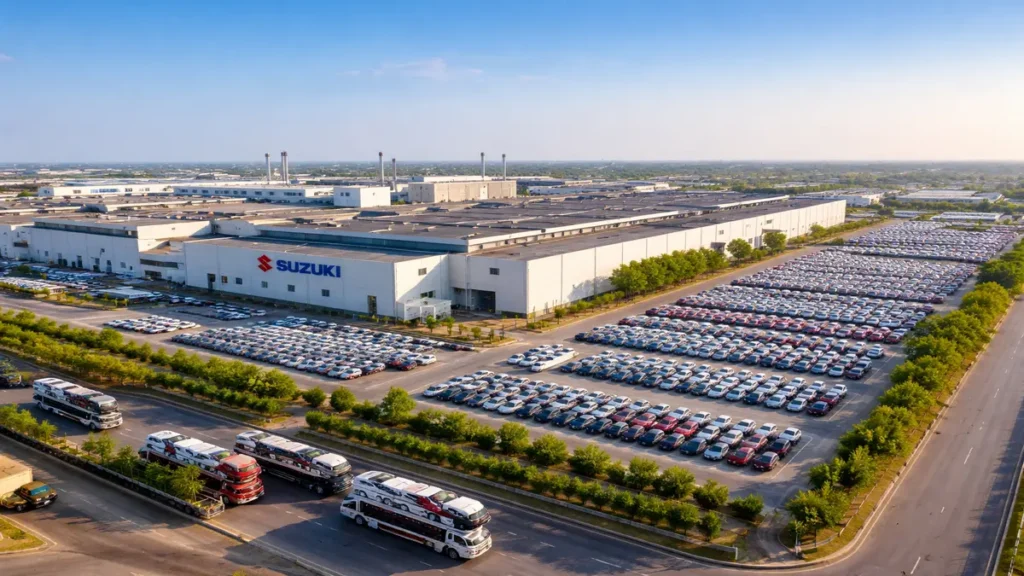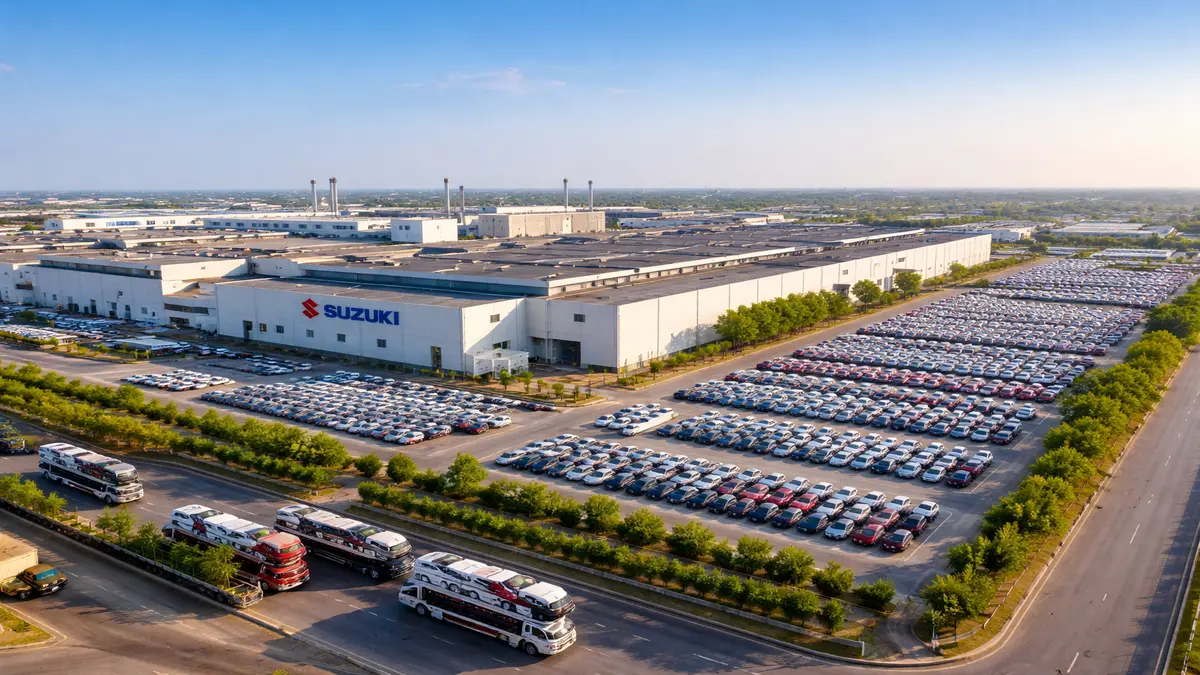
Maruti Suzuki Expands Production Capacity in Gujarat Plant with a new line and a new facility. Know full details, timelines, investment plans, and how it impacts car supply, exports, and EV future in India.
If you follow the Indian car market even a little, you already know one thing: Maruti Suzuki runs the heartbeat of India’s passenger vehicle industry. From small hatchbacks to compact SUVs, Maruti has built a massive customer base and an equally massive supply chain.
Now, Maruti Suzuki is taking a big step again — expanding production capacity in Gujarat. This is not just another “plant expansion” headline. It’s a strategic move that touches EVs, exports, future product plans, vendor ecosystems, job creation, and India’s position as a global manufacturing hub.
In this long, detailed blog-style article, I’ll explain the Gujarat expansion in the simplest possible language — but with complete depth. We’ll cover what Maruti is doing, why Gujarat, how much capacity is being added, what vehicles could be built there, how EV plans fit in, and what it means for customers and the market.
1) Quick Overview: What Exactly Is Maruti Suzuki Doing in Gujarat?
Maruti Suzuki has announced major capacity expansion plans in Gujarat in two key ways:
A) Expansion at existing Gujarat plant (Hansalpur / SMG)
Maruti’s wholly owned subsidiary in Gujarat — Suzuki Motor Gujarat (SMG) — currently produces around 7.5 lakh vehicles per year. Maruti plans to add a 4th production line there, taking the capacity up to 10 lakh vehicles annually. This new line is expected to become operational around FY 2026–27.
B) A new greenfield plant in Gujarat (Sanand / Khoraj industrial estate)
Maruti Suzuki’s board has approved land acquisition and investment for a new passenger vehicle plant in Gujarat which is expected to add 10 lakh vehicles per year capacity (1 million units annually).
In short:
- Existing Gujarat plant goes from 7.5 lakh → 10 lakh
- New Gujarat plant adds 10 lakh
- Total Gujarat annual capacity could eventually become 20 lakh vehicles per year (2 million)
This is HUGE.
2) Why Gujarat Has Become Maruti Suzuki’s Favourite Manufacturing Hub
To understand why Maruti is investing so heavily in Gujarat, you need to look at the bigger picture.
Strong export advantage
Gujarat’s ports (like Mundra, Pipavav, Kandla etc.) make vehicle exports easier and faster. Maruti exports to many markets, and Gujarat is naturally positioned for cost-efficient global shipping.
Supplier ecosystem is growing fast
Once a big OEM commits to a region, vendors follow. Gujarat has steadily grown its auto component ecosystem. That reduces:
- logistics costs
- delivery delays
- dependency on far-away suppliers
Large land availability
Gujarat offers space for scalable industrial growth. For auto manufacturing, you need land not just for the plant, but for:
- vendor parks
- logistics yards
- internal testing areas
- future line additions
Policy support and industrial infrastructure
Gujarat’s industrial policies and infrastructure are widely seen as pro-business, especially for large manufacturing projects.
So basically, Gujarat gives Maruti:
Exports + space + vendors + infrastructure + government support — all in one package.
3) What Is Maruti Suzuki Expands Production Capacity in Gujarat Plant (SMG) and Why Does It Matter?
A lot of people confuse Maruti’s Gujarat plant.
Maruti Suzuki has production facilities in Haryana (Gurugram, Manesar) and now Gujarat through SMG.
Suzuki Motor Gujarat (SMG) started as Suzuki’s facility in Gujarat, producing cars mainly for Maruti Suzuki India. Later, SMG became a wholly owned subsidiary of Maruti Suzuki, which means Maruti directly controls operations and future expansion decisions there.
SMG has been a key backbone for:
- Baleno
- Swift
- Fronx
(and more models over time)
And now, it is also becoming important for the EV journey.
4) Gujarat Expansion Plan: Capacity Numbers Explained Simply
Let’s break down the numbers in the easiest way:
Current Gujarat installed capacity
- SMG Hansalpur capacity: ~7.5 lakh units per year
After 4th line addition at Hansalpur
- Hansalpur becomes 10 lakh units annually
New Gujarat plant
- Adds 10 lakh units annually
Total Gujarat capacity: 20 lakh units annually (2 million)
Now remember: this isn’t “maximum output from next month”. These are planned milestones over the coming years.
5) How Big Is This Compared to Maruti’s Total India Production?
Maruti Suzuki already has multiple plants (Haryana + Gujarat + upcoming new ones).
Maruti has also publicly shared that it wants to reach about 4 million annual production capacity in India by FY 2030–31, using expansions across:
- Gujarat new plant
- SMG line expansion
- new Kharkhoda plant (Haryana)
and others
So Gujarat is not a side project.
It is literally a major pillar of the company’s next decade roadmap.
6) Why Maruti Needs More Capacity Right Now
Some people ask:
“Maruti already dominates the market, why expand so aggressively?”
Because the Indian car market is entering a new phase.
Demand is still rising
India’s passenger vehicle demand is growing and shifting towards:
- compact SUVs
- premium hatchbacks
- family vehicles
- EVs (in the coming years)
Waiting period pressure
Even today, popular Maruti models often have waiting periods depending on variant and region.
Increasing capacity is the only long-term solution.
Competition is intense
Tata, Hyundai, Kia, Mahindra — everyone is aggressively expanding capacity and launching SUVs and EVs. Maruti cannot afford supply limitations.
Export growth strategy
Suzuki wants India to become a global production hub. Reuters highlighted that Suzuki has broader India investment plans and export goals tied to new capacity.
7) Gujarat Expansion + EV Plans: The Real Game
This is where the story becomes much more serious.
Maruti’s Gujarat expansion is closely linked to EV manufacturing strategy.
Maruti had already announced that the 4th line at SMG is aimed keeping EV production in mind.
What this signals:
- Gujarat is likely to be a key base for Maruti EV production
- Gujarat will support both domestic EV demand + exports
- Maruti wants scalable capacity in a single state that is export-friendly
This makes total sense because EV supply chains and export models need:
- stable ports
- predictable logistics
- high-scale production
- vendor clustering
Gujarat checks all of these boxes.
8) New Gujarat Plant: Where Exactly Is It?
Reports indicate Maruti’s land acquisition and new investment is tied to areas like:
- Khoraj Industrial Estate
- Sanand region
Sanand is already a known auto manufacturing belt (other OEMs have presence nearby as well), so the region has industrial maturity.
This new plant is expected to be Maruti’s second vehicle manufacturing facility in Gujarat.
9) Investment Size: How Much Is Maruti Spending?
As per recent reports, Maruti Suzuki’s investment for the new Gujarat plant is around:
- ₹4,960 crore
This includes:
- land acquisition
- setup and infrastructure
- plant development
While the exact breakdown can vary, this signals strong long-term commitment.
10) What Models Could Be Produced in Gujarat After Expansion?
Maruti usually doesn’t reveal model-by-model plans immediately. But based on strategy, Gujarat is likely to handle:
High-volume models
Plants with massive installed capacity usually focus on high-volume vehicles such as:
- Swift / Baleno style products
- compact SUVs
- popular Nexa models
Export-heavy models
Gujarat is export-friendly, so models with strong export demand often make sense here.
EVs / future tech vehicles
Since the 4th line is closely linked to EV production future, Gujarat is being developed as:
Maruti’s future technology manufacturing zone.
11) What This Means for Buyers (Normal People Impact)
Let’s keep it real — how does this affect you and me?
1) Shorter waiting periods
When capacity increases, supply improves.
That usually results in:
- faster delivery time
- improved stock availability
- smoother demand handling during festive seasons
2) Better product variety
Higher capacity allows:
- more variants
- more colours
- more special editions
3) Competitive pricing stability
When production can scale easily, costs are more controlled.
That doesn’t mean “cheap cars”, but it helps Maruti maintain strong value pricing.
4) Faster EV rollout
With dedicated lines and capacity planning, EV production becomes more realistic and scalable.
12) What This Means for Gujarat (State-Level Impact)
Such a large investment transforms the region.
Job creation
Not only direct plant jobs, but:
- logistics
- vendor operations
- quality/testing teams
- facility management
- transport and warehousing
Supplier ecosystem growth
New vendors will set up factories nearby.
Infrastructure development
Roads, industrial connectivity, township demand — all improve over time.
So Gujarat benefits massively from such mega-manufacturing commitments.
13) Gujarat vs Haryana: Is Maruti Shifting Focus?
Not exactly. But there is a clear balancing strategy happening.
Haryana is traditional Maruti territory, but:
- land constraints
- urban expansion
- higher congestion
can make scaling difficult.
Gujarat offers a cleaner expansion canvas.
Also, Maruti is also expanding in Haryana via the Kharkhoda plant, so the strategy is not “shift away”, it is “expand everywhere smartly”.
14) The Supply Chain Angle: Why Capacity Expansion Is Not Just Adding Machines
Modern car manufacturing expansion is not just:
“put more robots and build more cars”
It involves:
- vendor readiness
- steel and alloy supply planning
- engine/transmission capacity
- battery supply (for EVs)
- semi-conductors and electronics supply
- logistics contracts
- port capacity allocation
So when Maruti announces such expansion, it means:
The company has already studied the supply chain and market demand for years ahead.
15) Exports: Gujarat Expansion Strengthens India’s Global Role
Suzuki’s bigger strategy is clear:
Make India a global hub for Suzuki cars and EVs.
Reuters also pointed out Suzuki’s broader plan around India expansion, exports and EV strategy.
So Gujarat isn’t just about India sales — it’s also about:
- Europe exports
- Africa exports
- Latin America exports
- emerging Asia exports
This matters because exports:
- stabilize production demand
- support currency inflow
- reduce dependency on only local sales
Related Post
Yamaha MT-15 V2 (2025) – The Street Fighter That Rules the Roads!
Hero Vida VX2 Electric Scooter
Suzuki Burgman Hydrogen Scooter 2025:200 KM Range & Eco Power
Kawasaki Ninja H2R – The Beast That Breaks All Limits
All BMW Bike Models, Price, Images, Specs
16) Gujarat Expansion and the Future of Maruti EV Plans
Maruti was late compared to Tata in EV launch.
That is true.
But Maruti is doing something classic:
scale first, launch strongly, dominate with volume.
Maruti knows that EV market success is not just “launch an EV”.
It’s:
- build service network
- ensure batteries are stable
- localize parts
- control pricing
- scale capacity
That is why Gujarat expansion matters.
It’s foundation work for the future.
17) What Happens Next: Timelines You Should Know
Based on official and credible reporting:
SMG 4th line
- expected operations: FY 2026–27
- capacity rise: 7.5 lakh → 10 lakh
New Gujarat plant
- capacity: 10 lakh
- currently in land acquisition / planning stage
Exact commissioning dates can shift, but the direction is locked.
18) Challenges Maruti May Face During This Expansion
Every big expansion has risks. Here are realistic ones:
1) EV supply chain uncertainty
Battery minerals, cell availability, localization — not always stable.
2) Capex pressure
Even for a giant like Maruti, ₹4,960 crore is significant investment.
3) Market shifts
If demand suddenly slows, capacity utilization may take time.
4) Competitor actions
Mahindra and Tata could accelerate EV leadership; Hyundai-Kia could increase SUV push.
But Maruti has one advantage: scale + network.
19) Industry Reaction: What Analysts Usually Read From This Move
Maruti’s Gujarat expansion signals:
- confidence in long-term demand
- readiness for EV future
- export expansion
- dominance strategy through volume leadership
In India, whoever controls manufacturing capacity often controls:
- supply
- pricing power
- dealership confidence
- market share retention
So this is not a “plant story”.
This is a “market leadership story.”
FAQs (People Also Ask)
1) How much capacity is Maruti adding in Gujarat?
Maruti plans to add a total of up to 20 lakh vehicles/year capacity in Gujarat: 10 lakh via expansion at SMG Hansalpur, and 10 lakh via a new plant.
2) When will the new production line start in Gujarat?
The 4th line at SMG Hansalpur is expected to start operations around FY 2026–27.
3) Why is Maruti Suzuki expanding in Gujarat?
Gujarat offers strong exports advantage, industrial infrastructure, land availability, and growing auto supplier ecosystem.
4) Is this expansion focused on electric vehicles?
Maruti has indicated the additional line at SMG is planned while keeping future EV production in mind.
5) How much investment is planned for the new Gujarat plant?
Recent reports mention ₹4,960 crore investment linked to land acquisition and expansion for a new Gujarat plant.
Conclusion: Gujarat Is Becoming Maruti Suzuki’s Next Big Powerhouse
Maruti Suzuki’s Gujarat expansion is not a short-term decision.
It is a long-term plan to:
- support India’s rising demand
- reduce waiting periods
- strengthen exports
- build EV manufacturing readiness
- reach the target of about 4 million capacity in India by FY2030–31
Gujarat is now shaping up to become one of the biggest Maruti Suzuki manufacturing ecosystems in the country — potentially producing 2 million cars per year when fully executed.
And if you think about it… that’s not just expansion.
That’s preparation for the next decade of Indian mobility.