Rivian R2 full review with design, interior, range, charging, pros-cons, and expected price in India. Real POV with comparison table & FAQs.
Hello friends,
If you follow cars even a little bit, you already know one thing—electric SUVs are everywhere now. But the problem is, most of them feel either too expensive, too “city-soft”, or too experimental. That’s why when Rivian officially revealed the Rivian R2, my first reaction was simple: this one feels like a real SUV first… and an EV second.
The Rivian R2 is a mid-size electric SUV coming from Rivian, a company known for the R1T and R1S—two vehicles that built a strong name in America for adventure-ready EVs. Now Rivian wants to bring that same brand DNA to a more affordable SUV, and R2 is the product.
In this detailed review, I’ll cover everything a real buyer wants to know:
- What the R2 actually is
- Design, size, practicality
- Interior experience (daily use comfort)
- Range, battery expectations, charging
- Performance variants explained in simple language
- Safety and tech features
- Expected price in India (realistic estimate)
- Comparison table with competitors
- Ownership perspective: service, parts, charging in India, running cost
- Battery degradation and warranty expectations
- Who should buy, who should wait
- FAQs
No overhype. No fanboy talk. Just an honest POV like a normal person.
1) What is Rivian R2?
The Rivian R2 is an upcoming 5-seater mid-size electric SUV, positioned below Rivian’s premium models. Rivian’s current vehicles—R1T and R1S—are great, but they’re premium, expensive, and heavy. Rivian knows that to grow big, they need a model that normal buyers can afford.
That’s where R2 comes in.
Why R2 matters (simple explanation)
- Rivian’s R1 models are premium and expensive
- R2 is planned as a high-volume global product
- Rivian targets a starting price around $45,000 in the US
- Production is expected to start around 2026
So basically, Rivian wants R2 to be their “mid-size mainstream Rivian,” a product that competes with cars like the Tesla Model Y—while keeping Rivian’s adventure vibe.
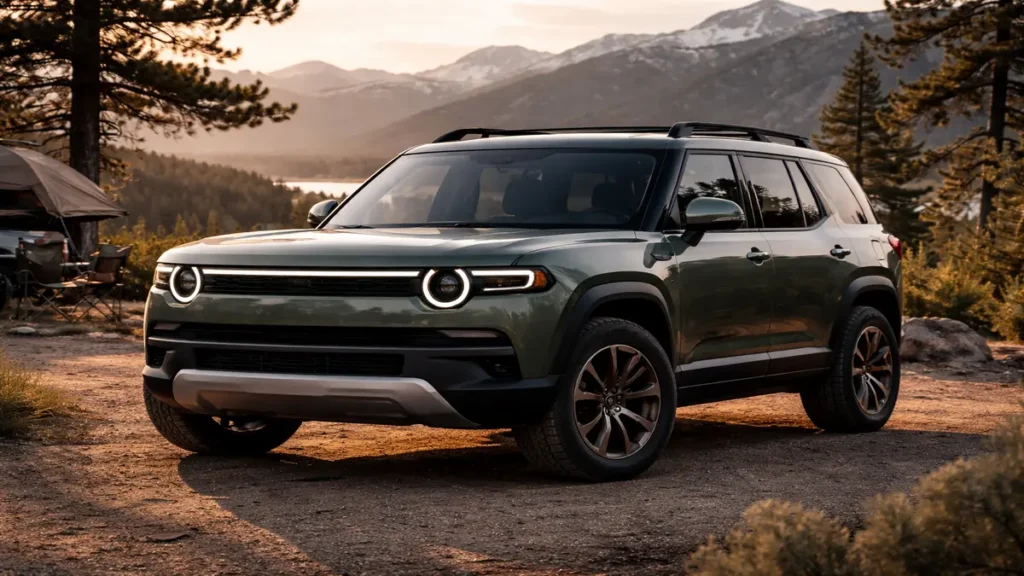
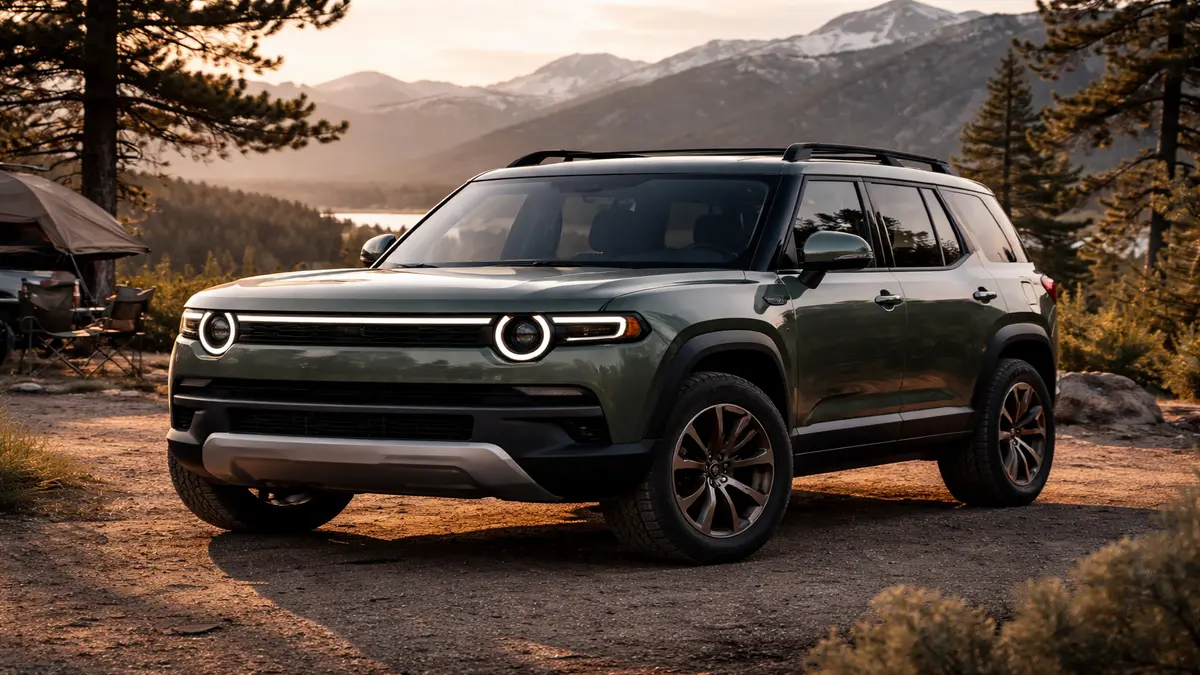
2) Rivian R2 Design: It Looks Like a Proper SUV
One thing I respect about Rivian is this: they don’t design cars like wind-tunnel eggs. The R2 looks clean, bold, and practical.
Key design points
- Boxy shape (better cabin use, better luggage practicality)
- Strong SUV stance, not a low crossover look
- Clean Rivian-style lights and modern face
- Tailgate-style rear with usable cargo design
- EV storage advantage: frunk (front trunk)
My POV
In India, people still prefer SUVs that look like SUVs. R2 has that “real SUV presence” instead of looking like a tall hatchback.
3) Size & Dimensions: Will it suit Indian roads?
R2 is mid-size in global terms, meaning it should be easier than big full-size SUVs in cities, while still being a proper family vehicle.
Expected overall idea:
- Similar segment size to Tesla Model Y
- More upright, boxy, SUV-like proportions
Ground clearance (important in India)
Ground clearance matters more than power in India. If Rivian keeps clearance healthy, speed breakers and broken roads will not feel scary.
My POV
R2 won’t feel tiny. It will have a strong presence. But width could be slightly more than typical Indian SUVs, so tight lanes and parking will require attention—especially in crowded markets.
4) Variants & Powertrains: Single vs Dual vs Tri-Motor
Rivian has confirmed multiple motor options for R2:
1) Single Motor (RWD)
- Most affordable version
- Best range per charge
- Smooth daily driving
2) Dual Motor (AWD)
- Best balanced option
- Better grip and stability (rain, highways, hills)
- Strong acceleration
3) Tri-Motor (AWD)
- Performance-focused variant
- Very quick acceleration
- Better off-road control potential
My POV
If I had to pick one variant for most buyers, I’d say the Dual Motor AWD will likely be the “sweet spot”—enough performance, strong grip, and still usable for daily driving.
5) Battery, Range & Real-World Expectations
Rivian has talked about 300+ miles of range. That’s impressive, but real-world range depends on driving style, weather, speed, and load.
Expected range (simple, realistic)
- Claimed: ~480+ km (approx.)
- City: 400–450 km possible
- Highway at 100–110 km/h: 330–400 km
- Full load + bad road + AC: 300–360 km
What reduces range most?
- High speed driving
- Heavy AC usage (Indian summers)
- Full load: 5 passengers + luggage
- Tyre pressure and tyre type
- Hill roads / slopes
My POV
If R2 delivers even 350–400 km real range consistently, that’s a very usable electric SUV for most Indian buyers—especially with home charging.
6) Charging: How practical will it be?
Charging is the heart of EV ownership.
In the US
R2 is expected to work with the Tesla network (NACS), which is a big plus there.
In India
If Rivian enters India, they will need:
- CCS2 fast charging support
- Home AC wallbox charging support
- Partnerships with charging operators
My POV
A premium EV without strong charging support in India becomes a showroom product, not a daily life product. Rivian must ensure charging compatibility and service support from day one.
7) Interior & Cabin: The “Daily Life” Experience
Now let’s talk about the most important part: cabin comfort.
Because honestly—range and performance are great, but your family lives inside the cabin.
Rivian interiors are usually:
- Minimal but premium
- Clean dashboards
- Focused on storage and usability
What to expect inside R2
- Big infotainment screen
- Digital driver display
- Premium seat materials
- Practical cabin storage spaces
- Good boot + frunk storage
Rear seat comfort (India POV)
Rear seat comfort matters a lot in India because family rides are common. Many EVs compromise rear comfort due to battery floor height. R2’s boxy design may help it offer better rear seat posture and space.
My POV
If Rivian gives proper rear seat comfort + rear AC vents and good insulation, R2 can become a true family SUV.
8) Practicality: Boot, Frunk & Storage
This is where EV SUVs can win.
Expected practical advantages:
- Frunk for bags
- Flat cabin floor design
- Wide boot space
- Split-fold rear seats
My POV
For Indian buyers, practicality beats performance. If R2 offers strong luggage space, flexible seating, and storage pockets everywhere, it will feel “life-friendly.”
9) Driving Feel: What kind of SUV will it be?
Rivian is known for:
- Strong acceleration
- Smooth power delivery
- Solid stability
- SUV-like confidence
What I expect in R2
- Smooth city driving
- Quiet cabin at low speeds
- Strong highway overtakes (EV torque advantage)
- Slightly heavy feel (battery weight)
My POV
A good EV SUV should feel:
- easy in city
- stable on highway
- comfortable over potholes
If Rivian tunes the suspension right, R2 will feel premium even without a German badge.
10) Safety & ADAS: Useful or annoying in India?
Rivian will definitely include strong safety systems.
Expected:
- Multiple airbags
- ABS + ESC
- Traction control
- Strong crash protection
- ADAS: adaptive cruise, lane keep, emergency braking, blind spot
Indian POV
ADAS is helpful but must be tuned for Indian traffic. Over-sensitive ADAS becomes irritating. If Rivian gets tuning right, it will add premium comfort on highways.
11) Rivian R2 Expected Price in India (Realistic Estimate)
Now the biggest question: price in India.
Rivian has not confirmed India launch officially, so pricing depends on how it enters the market.
Scenario 1: CBU import (most likely first)
Expected price: ₹70 lakh to ₹95 lakh (in our town)
- Depends on variant and equipment
- Includes heavy import duties and taxes
Scenario 2: Local assembly (long-term possibility)
Expected price: ₹50 lakh to ₹70 lakh
- Still premium but more competitive
My honest opinion
If it comes as CBU at ₹80–90 lakh, it becomes a luxury niche EV SUV.
If Rivian ever assembles locally, R2 becomes a serious player.
12) Rivian R2 vs Competitors (Comparison Table)
Here’s a clean comparison table with EVs Indian premium buyers already consider.
| EV SUV | Price (India) | Range (claimed) | Strength | Weakness |
| Rivian R2 | ₹70–95 lakh (est.) | 480+ km (est.) | SUV look + practical vibe | Not available yet |
| Kia EV6 | ₹60–65 lakh | 528 km | Sporty, fast charging | Less “SUV feel” |
| Hyundai Ioniq 5 | ₹45–50 lakh | 631 km | Comfort, big cabin | Limited availability |
| BMW iX1 | ₹66–70 lakh | ~440 km | Luxury badge + comfort | Range/value concern |
| Volvo XC40 Recharge | ₹55–60 lakh | ~418 km | Safety + build | Range/value concern |
| Tesla Model Y (expected) | Not confirmed | 450–530 km | Efficiency + tech | India launch uncertain |
My POV
R2’s biggest advantage is personality: it looks like an SUV and feels like an adventure EV, not like a tech gadget on wheels.
13) Ownership Reality: Service, Spares & Repairs (India)
This is the section most people ignore. But it’s the most important.
If Rivian is NOT officially present
- Service becomes complicated
- Parts become expensive and slow
- Small accidents can become big headaches
- Warranty claims become difficult
If Rivian launches officially
Then:
- Service network becomes the real success factor
- Warranty support must be strong
- Parts availability must be reliable
My POV
In India, even luxury brands can take time for parts supply. Rivian must build a service ecosystem; otherwise it stays an enthusiast-only import.
14) Running Cost in India: Cost per km (realistic)
EVs are cheaper to run than petrol/diesel SUVs.
Electricity cost
- Home charging: ₹7–10/unit (varies by city)
- Fast charging: ₹18–25/unit (depends operator)
Per km estimate
- Home charging: ₹1.2 to ₹2.0 per km
- Fast charging: ₹3.0 to ₹4.5 per km
Petrol SUVs often cost ₹8–₹12 per km, so EV savings are real over long term.
15) Battery Life & Degradation: The Truth People Avoid
Batteries degrade slowly over time.
What degradation can look like
- Year 1–2: almost no noticeable change
- After 3 years: 5–8% drop (depends usage)
- After 5 years: 10–15% drop
- After 8 years: 15–25% (rare worst-case)
Depends on:
- how often you fast charge
- heat exposure
- charging habit (100% daily is bad)
- driving style
Best battery habits
- Keep daily charging between 20–80%
- Avoid frequent 0% battery
- Don’t keep it parked at 100% for days
- Use fast charging only when needed
Warranty expectation
Most premium EVs offer around 8 years / 160,000 km battery warranty range. Rivian will need a strong warranty plan if it enters India.
16) India Charging Guide (Most Important Ownership Section)
If you have home charging, EV ownership becomes easy.
Home charging setup
Ideal:
- 7.2 kW wallbox charger
- proper wiring + earthing
- covered parking slot
Charging time estimate
Depending on battery size:
- Full charge: 8–12 hours
- Daily top-up (20–80%): 4–6 hours
Fast charging
Fast charging highways are improving, but still not perfect everywhere. R2’s long trips in India will depend heavily on charging network quality and uptime.
My POV
Rivian must partner with Indian charging networks and offer good charger-planning navigation. This is what separates successful EV brands from failed ones.
17) A Real Ownership POV: “If I Owned R2 in India…”
Let me put it into real life.
Daily city driving
EVs feel effortless:
- smooth pickup
- no gear shifts
- no engine heat
- silent ride
In traffic, an EV SUV like R2 will feel relaxed.
Parking and tight lanes
The R2’s width might feel big initially, but with 360 camera and sensors, it becomes manageable.
Weekend highway trip
Start at 100% charge. 5 passengers, luggage, AC on.
At 100–110 km/h, expect 330–400 km realistic highway range.
That means:
- one charging stop on long routes
- or a top-up at lunch
Charging stop reality
If the charger works: very easy ownership.
If the charger is down/busy: frustration.
So the real “R2 experience” in India will depend on the charging ecosystem.
18) Ride Comfort & Indian Roads
India has potholes and broken roads. Suspension tuning matters.
R2 will be:
- heavy enough for stability
- but must be tuned for comfort
My POV
If Rivian gives a comfort-focused suspension setup, R2 can become an amazing long-distance SUV.
19) Colors & Trims (Expected)
Rivian is known for classy, modern colors.
Expected vibes:
- Pearl White
- Midnight Black
- Silver/Grey
- Deep Blue
- Forest Green (Rivian identity color)
Trims
Most likely:
- Base (Single motor)
- Mid (Dual motor)
- Performance (Tri motor)
- Optional packs: tech pack, premium audio, off-road pack
20) Pros and Cons (Honest)
Pros
- Looks like a true SUV
- Strong expected range
- Practical storage (frunk + boot)
- Multiple variants (single/dual/tri)
- Premium build vibe
- Adventure identity (not boring)
Cons
- Not launched in India
- CBU import can be expensive
- Service + parts uncertainty
- Charging network dependence for road trips
21) Who Should Buy Rivian R2 (and who should not)
Consider Rivian R2 if:
- you want a premium electric SUV with proper SUV presence
- you do road trips and want practical storage
- you want something different from German luxury options
- you have home charging
Avoid / don’t wait if:
- you want easy service in every city
- you don’t have home charging
- you hate uncertainty in resale and spares
- you want low-risk ownership
My final advice
In India, the product is only half the story. Service and support are equally important. If Rivian launches officially, then yes—it can be worth waiting for.
Read More
Hyundai Loniq 6 Review: Stylish, Futuristic & Fully Electric Car in India
Kia EV9 Review 2025 – Specs, Price, Range & Global Market Insights
Kia EV3 – The Compact Electric SUV Redefining Affordable EV Mobility
FAQs ( Real Questions)
Q1) What is Rivian R2?
A mid-size electric SUV from Rivian designed to be more affordable than R1 models.
Q2) When will Rivian R2 launch?
Production is expected around 2026, deliveries after that.
Q3) Is Rivian R2 a 7-seater?
No, it’s expected as a 5-seater SUV.
Q4) What is Rivian R2 expected range?
300+ miles claimed globally, roughly 480+ km claimed.
Q5) What could be real-world range in India?
Around 330–450 km depending on conditions.
Q6) Will Rivian R2 support fast charging?
Yes, expected DC fast charging support.
Q7) Does Rivian R2 support home charging?
Yes, with a wallbox setup.
Q8) What is Rivian R2 expected price in India?
₹70–95 lakh (import estimate), ₹50–70 lakh if local assembly happens later.
Q9) Rivian R2 vs Kia EV6?
EV6 is sporty and available now; R2 offers more SUV character and storage vibe.
Q10) Is Rivian R2 good for Indian roads?
If clearance and suspension tuning stays strong, yes.
Final Verdict (My Real Opinion)
So brother, Rivian R2 looks like one of the most promising mid-size electric SUVs coming in 2026. It has what many EVs lack: SUV personality. It’s practical, modern, and still feels rugged.
But in India, the decision depends on:
- price (import vs local assembly)
- service network
- parts availability
- charging support
If Rivian R2 enters India officially with strong backing, the Rivian R2 can become a premium EV SUV that people genuinely desire—not just a fancy electric crossover.